Security
Dark Web Definition: What is It and How Does it Work?

Anthon Wansland
CMO & Founder
5 min
read
The definition of the dark web starts with what makes it different: it is a hidden part of the internet where users and websites can operate with a higher level of anonymity.
In this guide, we explain what the dark web is, how it works and why it matters for your personal data. You will also learn how cybercriminals profit from exposed information, and what you can do to reduce the risk of financial fraud and internet hackers.
4 Facts About the Dark Web
The dark web is a hidden part of the internet built around anonymity.
It cannot be accessed through regular browsers or search engines. Users usually need specific software, such as Tor, to reach dark web sites.
The deep web and dark web are not the same.
The deep web includes private online spaces you use every day, such as email, online banking and internal systems. The dark web is smaller and designed to hide identity and activity.
The dark web is not illegal by default, but it is often misused.
Some people use it for privacy, journalism or secure communication. But cybercriminals also use it to trade stolen data, malware, fake documents and illegal services.
Exposed data on the dark web can lead to real-world harm.
Stolen passwords, payment details, identity documents and personal information can be used for fraud, account takeover and identity theft. Dark web monitoring helps detect exposure earlier, so you can act faster.
What Is the Dark Web and What Happens There?
The dark web is a hidden part of the internet that cannot be accessed through standard search engines or regular browsers. It consists of websites, forums and marketplaces that usually require specific software, such as the Tor browser, to access.
Tor helps protect user privacy by masking identity, location and browsing activity. This can support legitimate use cases, including secure communication, journalism and access to information in restricted environments.
But the same anonymity also creates room for criminal activity. On the dark web, stolen login details, payment information, identity documents and other sensitive data can be traded, sold or shared. Cybercriminals may use this information for fraud, account takeover, phishing or identity theft.
That does not mean the dark web is only used by criminals. The risk comes from how anonymity can be misused. For individuals and businesses, the dark web matters because exposed data can move quickly from a breach to a marketplace, and from there into real-world security and financial harm.
> Understand the different types of exposure in our article.
The Surface Web: The Part of the Internet You Use Every Day
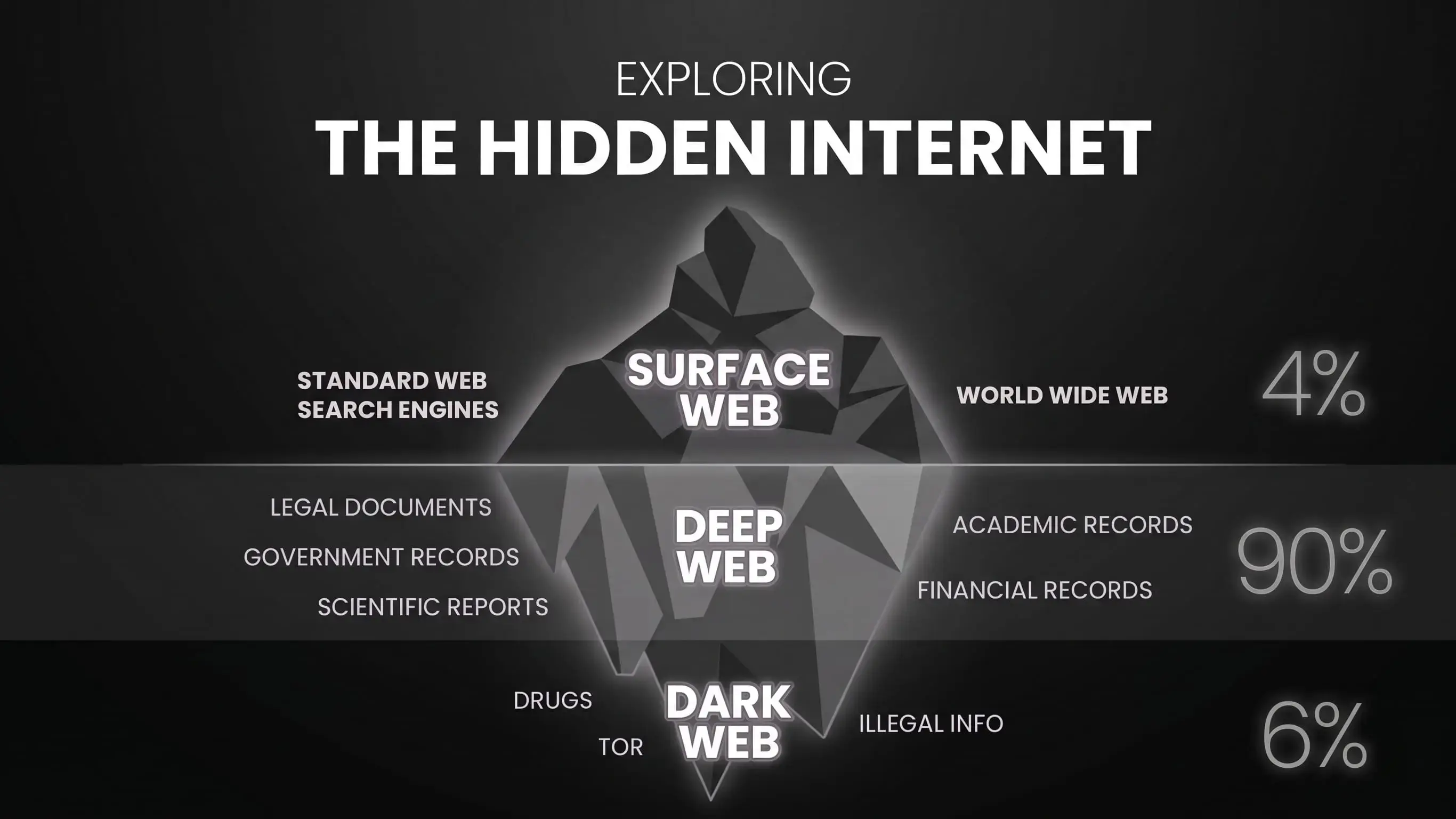
The internet has different layers: the surface web, the deep web and the dark web.
The surface web is the part most people are familiar with. It includes the public websites you can find through search engines, such as news sites, company websites, public sector pages and platforms like Wikipedia.
But this is only the visible part of the internet.
A large amount of online content does not appear in search results. That does not mean it is suspicious. In most cases, it is simply content that should not be public. Think of online banking, private accounts, medical portals, internal business systems, databases and subscription-based platforms.
So while the surface web is the part we use most often, it is only one layer. Beneath it is the deep web, where most private and protected online information lives.
Dark Web Vs. Deep Web: What's the Difference?
The deep web and the dark web are often confused, but they are not the same.
The deep web is the part of the internet that does not appear in search results. You use it every day when you log in to your email, online banking, social media accounts or internal work systems.
Most of the deep web is private for a reason. It can include:
Databases
Email accounts
Online banking
Intranets
Private forums
Paywall-protected content
The dark web is different. It is a smaller, hidden part of the internet that usually requires specific software to access. It is built around anonymity.
That anonymity can protect privacy. But it can also be misused. On the dark web, stolen login details, payment information and identity documents may be sold, shared or used for fraud.
The simple difference is: The deep web protects private information. The dark web hides identity and activity.
Why Does the Dark Web Exist?
The dark web exists because some people need more privacy online.
It uses hidden networks, to make it harder to see who is visiting a website, where they are located and what they are doing. Instead of connecting directly to a website, the traffic is sent through several steps to help hide the user’s identity.
This can be used for legitimate reasons. For example, journalists, activists and people in restricted countries may use the dark web to communicate more safely.
But the same anonymity can also be misused. Cybercriminals may use the dark web to hide their activity, sell stolen data or share illegal content.
That is why the dark web matters from a security perspective. It is not dangerous because it is hidden. It becomes a risk when anonymity is used to protect criminal activity.
The Engines of the Dark Web
To access the dark web, users need specific privacy-focused networks that sit on top of the regular internet. These are often called overlay networks.
The most well-known example is Tor, short for The Onion Router. Other networks, such as I2P and Freenet, also offer ways to browse or share information with more anonymity.
The main idea is simple: instead of connecting directly from your device to a website, your traffic is sent through several steps first.
This process is called onion routing:
Your data is wrapped in several layers of encryption.
It is sent through multiple volunteer-run servers, called nodes.
Each node removes one layer of encryption.
Each node only knows where the data came from and where it should go next.
No single node can see both who you are and which website you are visiting.
This makes it harder to trace activity back to a specific person. It can protect privacy, but it can also make it easier for criminal activity to stay hidden.
Is the Dark Web Dangerous?
The dark web is not dangerous by default. But it can become risky because it gives cybercriminals a place to hide, communicate and trade stolen information.
The biggest risks are often found in dark web marketplaces and forums. This is where stolen data can be bought, sold or shared.
That data can include:
Personal information: Names, addresses, phone numbers, dates of birth, email addresses and other details that can identify you.
Financial information: Credit card details, bank logins, insurance records and cryptocurrency account credentials.
Account logins: Usernames and passwords for email, social media, streaming services, work tools and other online accounts.
Medical information: Health records, prescriptions, test results, billing details and biometric data, such as fingerprints or facial images.
Company data: Internal documents, customer data, intellectual property, patents and other confidential business information.
Fake or stolen documents: Passports, driver’s licenses, ID cards and other forged or stolen documents.
All examples above are why dark web monitoring matters. It can help detect exposed data earlier, so you can take action before the damage spreads.
Market Prices for Stolen Information on the Dark Web
The dark web functions as a massive, unregulated marketplace. Our research and monitoring of these forums show that personal data is often sold in bulk ("logs") or as individual items. To give you an idea of the scale, here are typical prices for stolen information on the dark web:
Stolen credit card details: $5 – $20 (often including CVV and expiry date).
Social media logins (Facebook/Instagram): $25 – $45 per account.
Scanned passports: $1,000 – $2,000 depending on the country.
Subscription services (Netflix/Spotify): $1 – $3 for lifetime access.
These low prices reflect the sheer volume of data available; cybercriminals rely on selling thousands of records to turn a high profit.
Common Risks of the Dark Web
The dark web is not dangerous just because it is hidden. The risk comes from what you may find there, and what can happen if you interact with the wrong sites, files or people.
Some of the main risks include:
Legal consequences: Many dark web marketplaces are linked to illegal products and services. Accessing or buying illegal material can lead to serious legal consequences.
Limited protection: The dark web does not offer the same safety checks you may be used to from regular browsers. You may not get clear warnings about phishing pages, malicious links or unsafe websites.
Malware and infected files: Dark web sites can expose your device to malware, ransomware, spyware or trojans. A single download or wrong click can put your data at risk.
Financial scams: Scams are common. Users can be tricked into paying for fake products, sharing sensitive information or becoming involved in illegal activity without fully understanding the risk.
Exposure to criminal networks: Some dark web forums and marketplaces are used to trade stolen data, malware, fake documents and other criminal services. Even browsing these spaces can create unnecessary legal and security risks.
Global Law Enforcement Actions
While the dark web provides a shield for criminals, it is not a lawless vacuum. Global agencies like the FBI, Europol, and Interpol actively monitor and dismantle major dark web operations.
Notable examples include the 2022 takedown of Hydra Market by German and U.S. authorities, which at the time was the world's largest dark web marketplace. And Operation Cookie Monster in 2023, which seized the Genesis Market.
Safety Checklist: 5 Steps to Take if Your Data is Exposed
If you receive an alert that your information has been found on the dark web, don't panic. Follow this checklist to secure your digital identity:
Change your passwords immediately: Start with your email and banking accounts. Use a password manager to create unique, complex passwords for every site.
Enable Multi-Factor Authentication (MFA): Even if a criminal has your password, MFA acts as a second barrier that they usually cannot bypass.
Freeze your credit or monitor statements: Contact your bank to look for unauthorized transactions and, if necessary, place a freeze on your credit report to prevent new accounts from being opened in your name.
Scan your devices: Run a deep scan with reputable anti-malware software to ensure no "info-stealer" trojans are currently active on your computer.
Revoke third-party access: Check your account settings (Google, Facebook, etc.) and log out of all active sessions and "authorized apps" that you no longer use.
Also read: How to Protect Your Digital Footprint – 10 easy ways
Take Action Against Identity Theft: Proactive Protection with Serus
The dark web may be hidden, but your personal and corporate data shouldn't be a blind spot.
At Serus, we bridge the gap between hidden threats and proactive security. Our platform doesn't just explain the dark web – it monitors it for you, 24/7.
Why Choose Serus for Dark Web Monitoring?
Real-time exposure alerts: We notify you the moment your credentials, emails, or sensitive data appear on known dark web forums or marketplaces.
Comprehensive coverage: Our technology scans thousands of hidden layers, including invite-only chat rooms and encrypted paste-sites that standard tools miss.
Actionable intelligence: We don't just give you a warning; we provide clear guidance on how to secure your accounts and mitigate damage.
Enterprise-grade security: Whether you are protecting your personal identity or your company’s intellectual property, our solutions are built to scale with your needs.