Understand the different types of exposure


 Expand
6 min read
When it comes to online privacy, most people are aware that their personal information exists somewhere on the internet. What many don't realize is just how many places that information can appear — and how differently each type of exposure can affect them.
Serus identifies three distinct categories of exposure: dark web exposure, surface web exposure, and data broker exposure. Each one represents a different way your personal information can be accessed, shared, or misused. Understanding the differences between them is an important step toward taking control of your digital footprint.
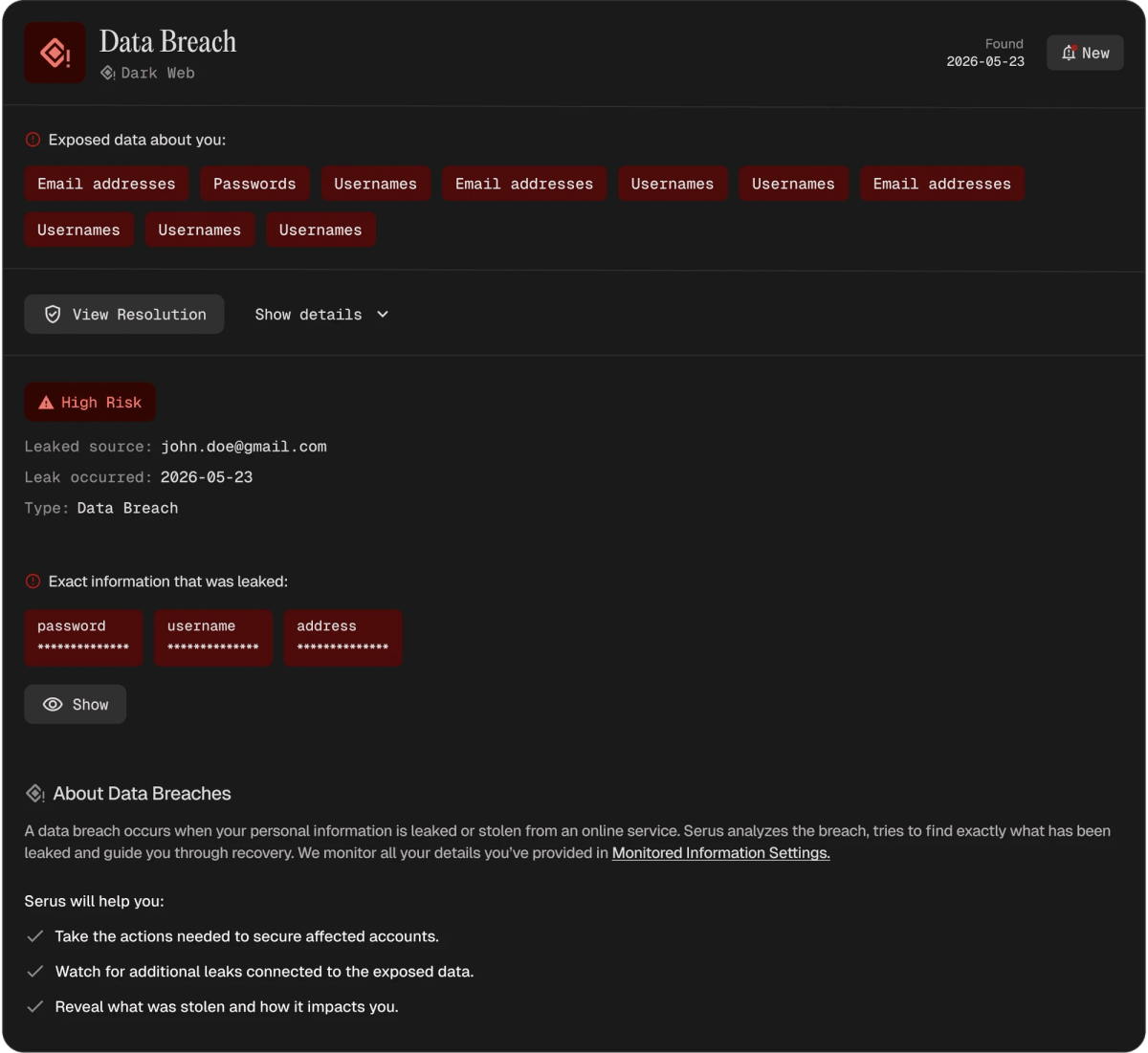
Dark Web Exposure
The dark web is a part of the internet that is not indexed by standard search engines and requires specialized software to access. It is commonly associated with illegal marketplaces, stolen credentials, and leaked databases. When a company experiences a data breach, the compromised information — such as email addresses, passwords, phone numbers, and financial details — often ends up being sold or distributed on dark web forums and marketplaces.
Dark web exposure is particularly concerning because it typically involves information that was never meant to be public in the first place. Unlike a social media profile or a public record, this data has been stolen. If your information appears on the dark web, it may indicate that one or more accounts you hold have been compromised at some point.
What dark web exposure can include
Leaked credentials such as email and password combinations, personal identifiers like social security numbers or national ID numbers, financial information including credit card numbers and bank account details, medical records, and private communications are all commonly found in dark web leaks.
Why it matters
The presence of your information on the dark web increases the risk of identity theft, account takeover, and targeted phishing attacks. Because this data circulates in environments that are difficult to monitor and nearly impossible to regulate, early detection is critical. The sooner you know your data has been exposed, the sooner you can take steps like changing passwords, enabling two-factor authentication, and monitoring your accounts for suspicious activity.
 Expand
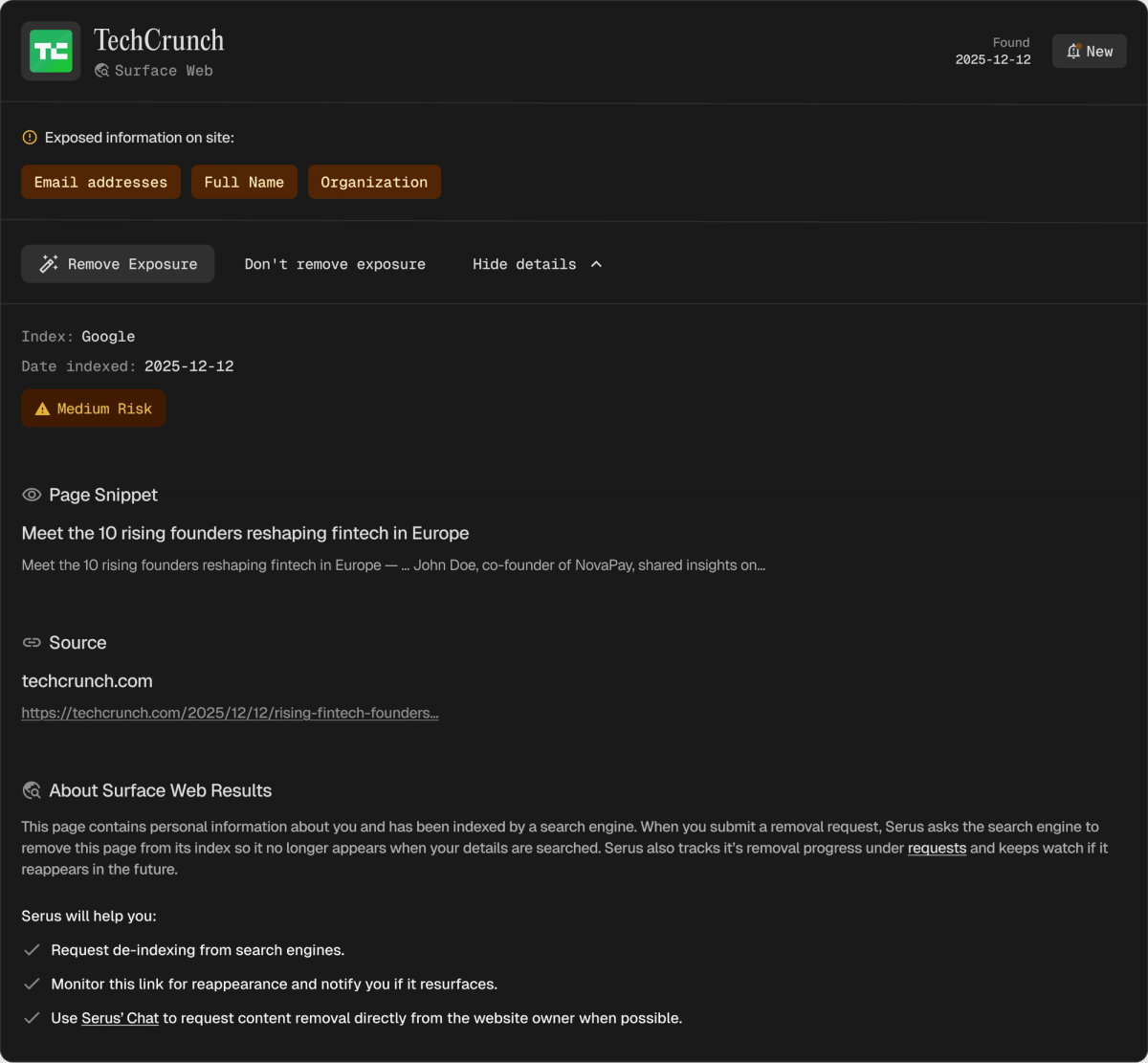
Surface Web Exposure
The surface web refers to the portion of the internet that is publicly accessible and indexed by search engines like Google, Bing, and others. Surface web exposure occurs when your personal information appears in search results, public directories, social media profiles, news articles, court records, or other publicly accessible websites.
This type of exposure is often the most visible, yet it is frequently overlooked. Many people do not regularly search for their own name or monitor what information about them is publicly available. Over time, personal details can accumulate across a wide range of websites, creating a surprisingly detailed and accessible profile of who you are.
What surface web exposure can include
Your full name, home address, phone number, email address, employment history, photos, social media activity, legal records, and even family member details can all appear in surface web results. In many cases, this information is aggregated from multiple sources, making it easy for anyone — employers, acquaintances, or bad actors — to piece together a comprehensive picture of your life.
Why it matters
Surface web exposure affects your privacy, your reputation, and your security. Publicly available personal information can be used for social engineering attacks, where someone uses known details about you to gain your trust and manipulate you into revealing more sensitive information. It can also affect professional opportunities, personal relationships, and your general sense of privacy. Because this information is accessible to anyone with an internet connection, it represents one of the most immediate and practical privacy concerns for most individuals.
 Expand
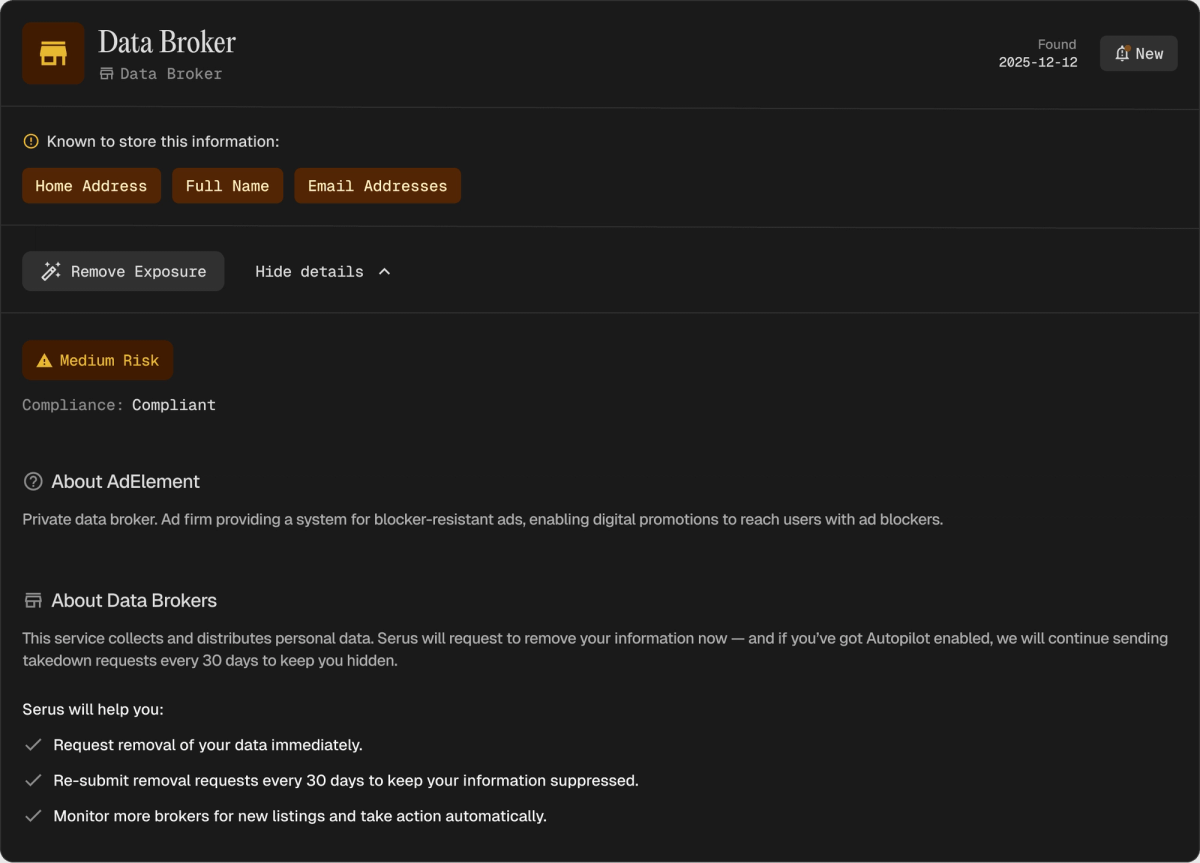
Data Broker Exposure
Data brokers are companies that collect, aggregate, and sell personal information. They gather data from a wide range of sources — public records, online activity, purchase histories, social media, surveys, and more — and compile it into detailed profiles that are then sold to marketers, advertisers, background check services, and other third parties.
Most people have never heard of the specific data brokers that hold their information, yet dozens or even hundreds of these companies may have a profile on any given individual. Sites like Spokeo, WhitePages, BeenVerified, and many others operate in this space, and they make it their business to know as much about you as possible.
What data broker exposure can include
Data broker profiles typically contain your name, current and past addresses, phone numbers, email addresses, age, family members, estimated income, property ownership records, court records, and sometimes even political affiliations and purchasing habits. The depth of information varies by broker, but the cumulative picture across multiple brokers can be remarkably detailed.
Why it matters
Data broker exposure is problematic for several reasons. First, it happens almost entirely without your knowledge or explicit consent. While the data itself may be sourced from technically public or permissible channels, the act of compiling and selling it raises significant privacy concerns. Second, this information is often used to make decisions about you — from the ads you see to whether you pass a background check — without your direct involvement. Third, the sheer number of data brokers means that removing your information is not a one-time task. Even after opting out of one broker, your data may reappear as it is re-collected or shared by others.
 Expand
How the Three Types of Exposure Differ
While all three categories involve your personal information being available to others, they differ in important ways.
Dark web exposure is the result of data breaches and criminal activity. The information is stolen and traded in hidden environments. Surface web exposure involves information that is technically public but may still be harmful when easily accessible or aggregated. Data broker exposure sits somewhere in between — the data is collected through legal means but is compiled and sold in ways that most people are unaware of and would not consent to if given the choice.
Each type of exposure also requires a different response. Dark web exposure calls for immediate action such as changing passwords and securing accounts. Surface web exposure may require submitting removal requests to websites and search engines. Data broker exposure involves opting out from individual brokers, a process that can be tedious and ongoing without the right tools.
What You Can Do About It
Awareness is the first step. Knowing where your information appears — and in what form — gives you the foundation to take meaningful action. Serus is designed to identify all three types of exposure and give you a clear picture of your digital footprint.
From there, you can choose to address each category individually or use features like Autopilot to handle removal requests automatically. Whether you are concerned primarily about dark web leaks, surface web visibility, or data broker profiles, having a comprehensive view of your exposure is essential to making informed decisions about your privacy.
Online privacy is not a single problem with a single solution. It is a collection of different challenges, each requiring its own approach. By understanding the types of exposure you face, you are better equipped to protect yourself in a meaningful and lasting way.
Want to see where your information is exposed? Get started with Serus today.
 Expand