Published
Scams, exposure, erasure: how people protect themselves online
Four years of search data and 118,045 AI questions across 21 countries. Every month, people around the world run about 1.1 billion scam checks on Google and AI assistants. That's an estimate, with an 80% range of 0.99 to 1.30 billion, and most of it now happens inside AI chats. Millions also try to get their own personal data off the internet: about 6.7 million searches and AI questions a month, every month. We measured both, along with how often people look each other up on people-search sites, using 755,789 search terms in 12 languages and four years of monthly Google data.

Head of Product & Co-Founder

Reviewed by Filip Landgren, PhD
CEO & Co-Founder
What we did
We measured 755,789 search terms across 21 countries and 12 languages, with four years of monthly Google search volume. We also analysed 118,045 questions people asked ChatGPT and Google's AI answers, and tested what ChatGPT does when asked to remove personal data.
What we found
People run an estimated 1.1 billion scam checks a month worldwide, most of them in AI assistants, and Google scam-check searches are up 47% in three years. Removing personal data happens at scale too: about 6.7 million searches and AI questions a month. AI assistants can explain how to do it, but in our test they did none of it themselves.
Key numbers
-
~1.1 billion
scam checks a month
About 1.1 billion scam checks a month happen worldwide on Google and AI assistants combined (80% range 0.99 billion to 1.30 billion).
worldwide · Monthly estimate, 2026 80% range 0.99 to 1.30 billion
How to cite: Serus, “Scams, exposure, erasure: how people protect themselves online” (Oct 2026), About 1.1 billion scam checks a month happen worldwide on Google and AI assistants combined (80% range 0.99 billion to 1.30 billion). https://www.serus.ai/research/scams-exposure-erasure/#worldwide-scam-checks
-
~6.7 million
searches and AI questions a month
About 6.7 million searches and AI questions a month are about removing personal data from the internet (80% range 5.1 million to 9.4 million).
worldwide · Monthly estimate, 2026 80% range 5.1 to 9.4 million
How to cite: Serus, “Scams, exposure, erasure: how people protect themselves online” (Oct 2026), About 6.7 million searches and AI questions a month are about removing personal data from the internet (80% range 5.1 million to 9.4 million). https://www.serus.ai/research/scams-exposure-erasure/#worldwide-removal
-
16.7 million
Google searches a month
At least 16.7 million Google searches a month in 21 countries explicitly ask whether something is a scam.
21 countries · Oct 2025 to Sep 2026
How to cite: Serus, “Scams, exposure, erasure: how people protect themselves online” (Oct 2026), At least 16.7 million Google searches a month in 21 countries explicitly ask whether something is a scam. https://www.serus.ai/research/scams-exposure-erasure/#google-scam-checks
-
+47%
percent change over 3 years
Scam-check searches grew 18% in the last year and 47% over three years.
21 countries · Oct 2022 to Sep 2026
How to cite: Serus, “Scams, exposure, erasure: how people protect themselves online” (Oct 2026), Scam-check searches grew 18% in the last year and 47% over three years. https://www.serus.ai/research/scams-exposure-erasure/#scam-check-growth
-
29.8
searches per 1,000 people a month
People in the US make about 30 scam-check searches a month for every 1,000 residents, the highest rate of the 21 countries.
United States · Oct 2025 to Sep 2026
How to cite: Serus, “Scams, exposure, erasure: how people protect themselves online” (Oct 2026), People in the US make about 30 scam-check searches a month for every 1,000 residents, the highest rate of the 21 countries. https://www.serus.ai/research/scams-exposure-erasure/#us-scam-rate
-
+146%
percent change over 3 years
Scam checks about investment, crypto and loans grew 146% over three years, faster than any other channel.
21 countries · Oct 2022 to Sep 2026
How to cite: Serus, “Scams, exposure, erasure: how people protect themselves online” (Oct 2026), Scam checks about investment, crypto and loans grew 146% over three years, faster than any other channel. https://www.serus.ai/research/scams-exposure-erasure/#fastest-scam-channel
-
13.1 million
Google searches a month
People-search sites get at least 13.1 million lookup searches a month across the 21 countries.
21 countries · Oct 2025 to Sep 2026
How to cite: Serus, “Scams, exposure, erasure: how people protect themselves online” (Oct 2026), People-search sites get at least 13.1 million lookup searches a month across the 21 countries. https://www.serus.ai/research/scams-exposure-erasure/#people-lookups
-
10
lookups per removal search
In the US, searches to look someone up outnumber all searches to remove personal data by about 10 to 1.
United States · Oct 2025 to Sep 2026
How to cite: Serus, “Scams, exposure, erasure: how people protect themselves online” (Oct 2026), In the US, searches to look someone up outnumber all searches to remove personal data by about 10 to 1. https://www.serus.ai/research/scams-exposure-erasure/#lookups-per-removal
-
2.0 million
Google searches a month
At least 2.0 million Google searches a month in 21 countries are about getting personal data removed.
21 countries · Oct 2025 to Sep 2026
How to cite: Serus, “Scams, exposure, erasure: how people protect themselves online” (Oct 2026), At least 2.0 million Google searches a month in 21 countries are about getting personal data removed. https://www.serus.ai/research/scams-exposure-erasure/#removal-searches
-
+48%
percent change over 3 years
Searches for removal services by name grew 48% over three years, while do-it-yourself removal searches fell 21% in the last year.
21 countries · Oct 2022 to Sep 2026
How to cite: Serus, “Scams, exposure, erasure: how people protect themselves online” (Oct 2026), Searches for removal services by name grew 48% over three years, while do-it-yourself removal searches fell 21% in the last year. https://www.serus.ai/research/scams-exposure-erasure/#removal-services-growth
-
91%
percent of answers
91% of Google AI answers to data-removal questions recommend a paid service (panel of 725 answers).
United States · AI answer panel, collected 20 Oct 2026
How to cite: Serus, “Scams, exposure, erasure: how people protect themselves online” (Oct 2026), 91% of Google AI answers to data-removal questions recommend a paid service (panel of 725 answers). https://www.serus.ai/research/scams-exposure-erasure/#ai-paid-service
-
0
removal requests carried out
Asked to remove personal data in 6 separate prompts, ChatGPT carried out none of them and gave instructions instead (test on 20 Oct 2026).
test · Test, 20 Oct 2026
How to cite: Serus, “Scams, exposure, erasure: how people protect themselves online” (Oct 2026), Asked to remove personal data in 6 separate prompts, ChatGPT carried out none of them and gave instructions instead (test on 20 Oct 2026). https://www.serus.ai/research/scams-exposure-erasure/#ai-removal-requests
Summary
The study has two parts. Part I covers scam checks: searches that try to find out whether a shop, a message, an app or a website can be trusted. Part II covers exposure and data removal: how often people look others up on people-search sites, and how often people try to take their own information down.
Scam checks
- Checking before trusting is routine. At least 16.7 million Google searches a month in our 21 countries explicitly ask whether something is a scam. That's about 19 for every 1,000 people, and 30 per 1,000 in the US.
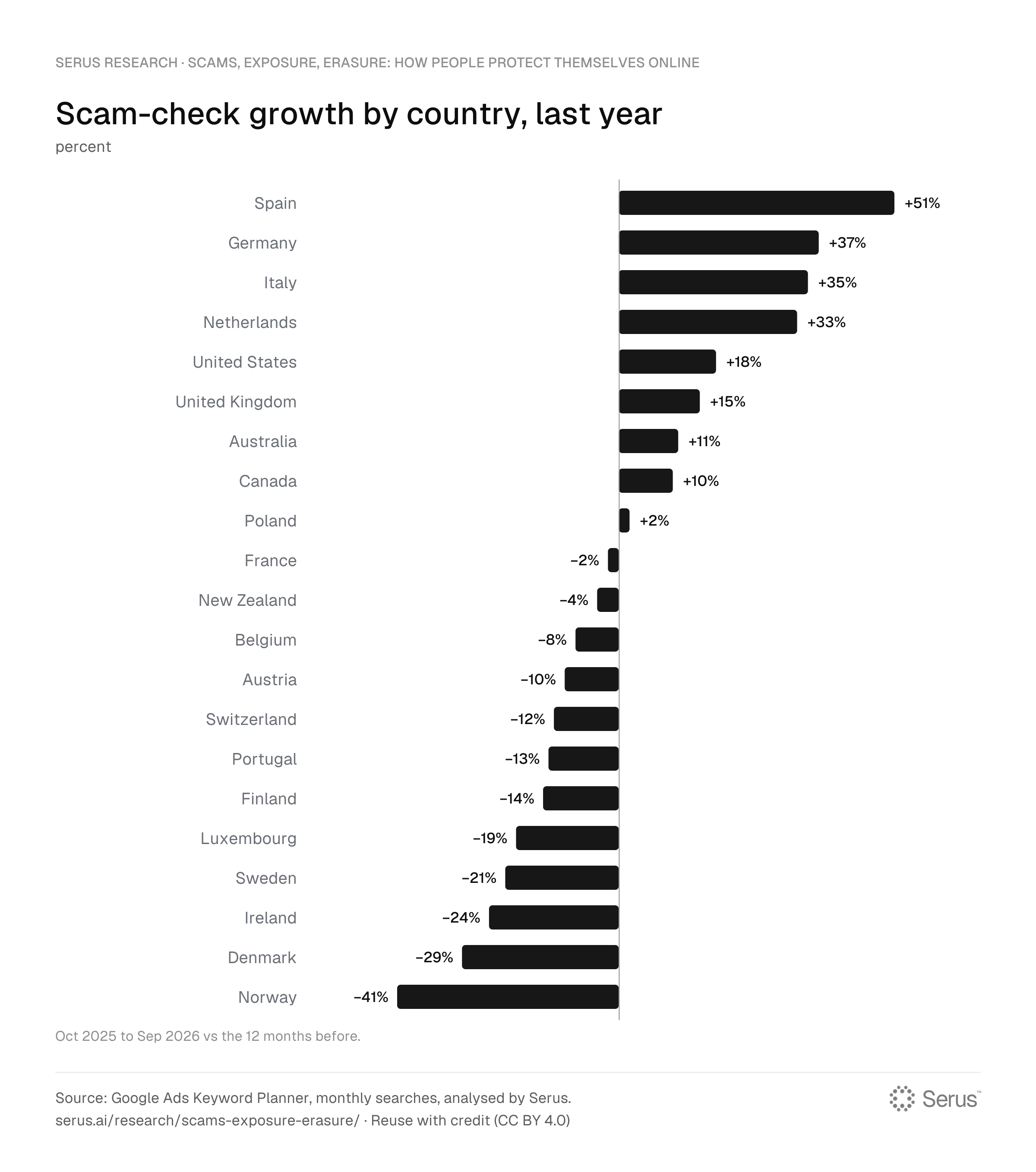
- It grows every year: up 18% in the last year and 47% over three years. Spain (+51%), Germany (+37%), Italy (+35%) and the Netherlands (+33%) grew fastest last year.
- Most checks are about where to spend money. Online shops and marketplaces lead, then apps that promise to pay you, then ticket resellers.
- AI assistants are now where most checking happens. OpenAI says 24.7 million people a week use ChatGPT to check a possible scam. Given a suspicious message, the assistant gives a clear verdict.
Exposure and data removal
- Being findable is the norm. People-search sites get at least 13.1 million lookup searches a month. In the US, lookups outnumber every kind of removal search combined by about 10 to 1.
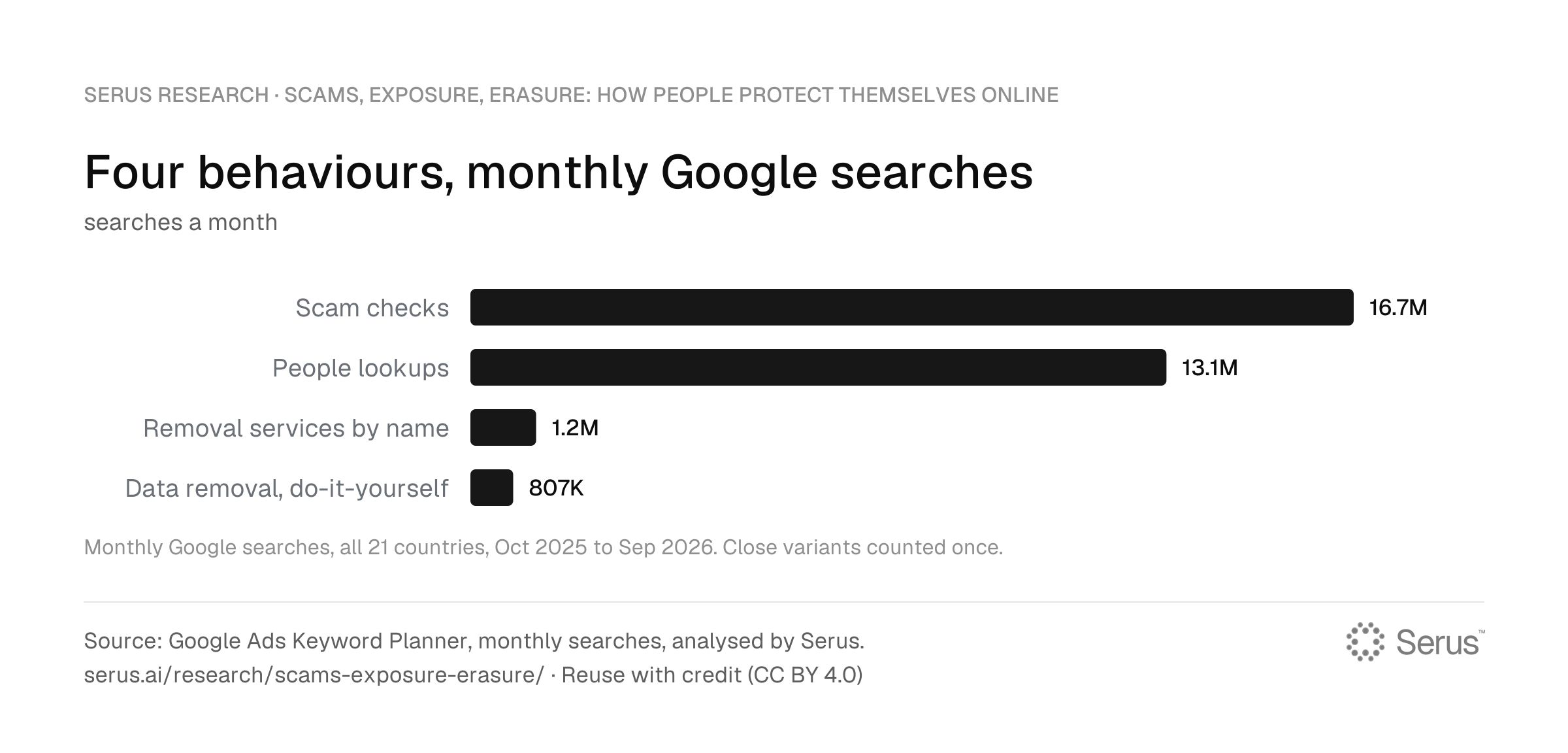
- Removal happens at scale: an estimated 6.7 million searches and AI questions a month worldwide. In our 21 countries alone, that's about 2 million Google searches a month: 807,000 do-it-yourself removal searches and 1.2 million for a removal service by name.
- It's moving from "how do I" to "who can do this for me". Do-it-yourself removal searches fell 21% in the last year after a surge in 2025. Searches for removal services by name rose 48% over three years.
- AI can't do the removal. When asked to remove personal data in 6 different ways, ChatGPT declined each time and gave instructions instead. Google's AI answers to removal questions recommend a paid service 91% of the time.
Four behaviours, monthly Google searches
searches a month
| Label | searches a month |
|---|---|
| Scam checks | 16,658,950 |
| People lookups | 13,127,500 |
| Removal services by name | 1,239,630 |
| Data removal, do-it-yourself | 807,030 |
Part I: Scam checks
A scam check, in this study, is a search that tries to verify something specific: "is this a scam", "is this website legit", "fake shop finder", "est-ce une arnaque", "czy to oszustwo". General interest ("what is phishing") and reporting ("report a scam") are measured separately and left out of the headline numbers.
The stakes are high. US consumers reported losing $15.9 billion to fraud in 2025, up from $12.5 billion the year before (FTC). The FBI's Internet Crime Complaint Center logged about 1 million complaints and $20.9 billion in losses (FBI IC3 2025 report, via Help Net Security). Worldwide, 57% of adults in a 42-market survey said they had faced a scam in the past year (GASA and Feedzai, 2025).
How many people check, and where
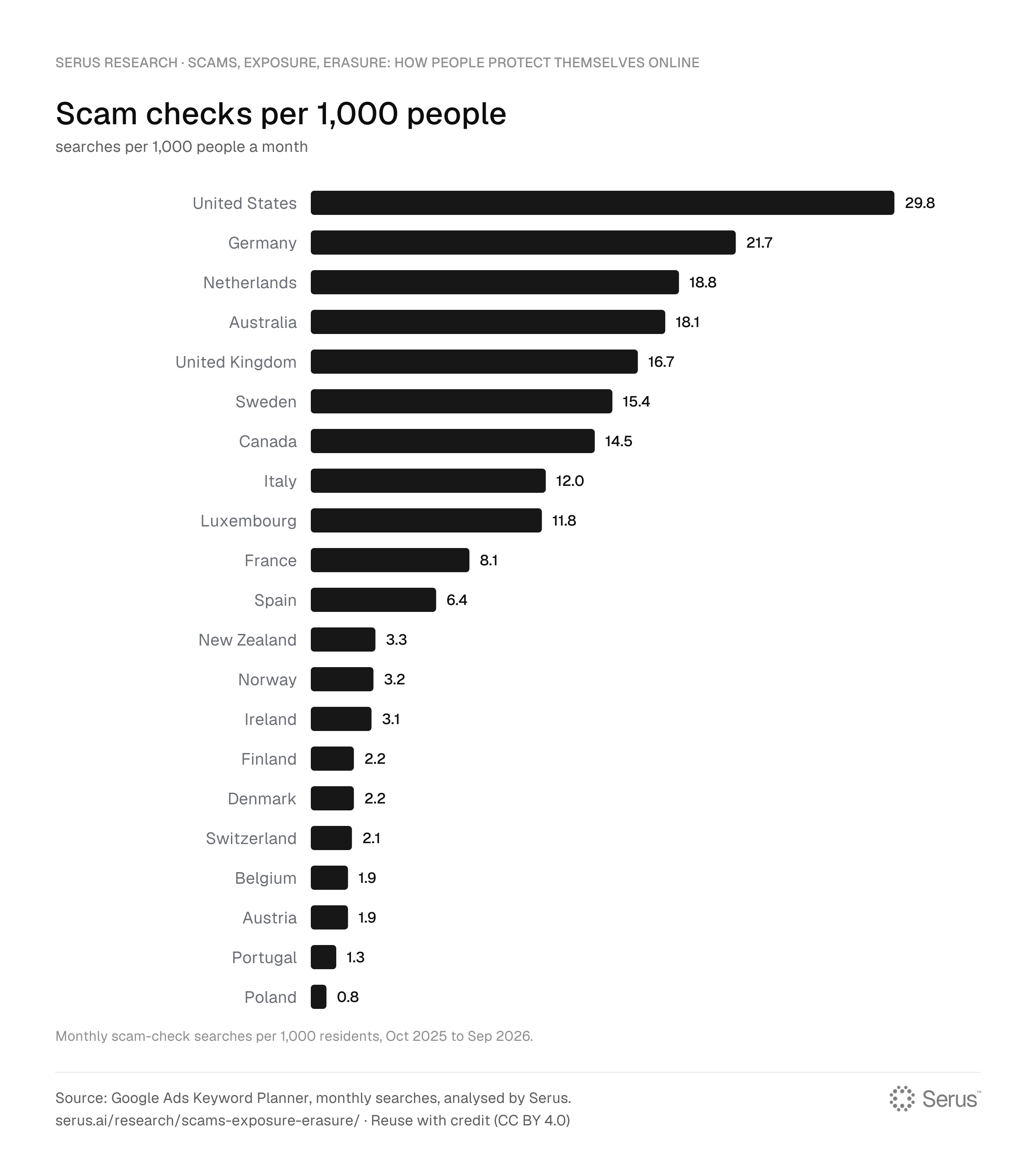
Across the 21 countries, people search to check whether something is a scam at least 16.7 million times a month. The US accounts for 10.4 million of those searches. Per person, the US rate (30 a month per 1,000 residents) is nearly twice the UK's (17) and almost three times the EU average (11).
Germany is second at 22 per 1,000. Much of that comes from one tool: German shoppers search "Fake-Shop Finder" before buying from an unfamiliar store. Those searches went from about 4,400 a month in late 2022 to 110,000 in November and December 2025.
Scam checks per 1,000 people
searches per 1,000 people a month
| Label | searches per 1,000 people a month |
|---|---|
| United States | 29.8 |
| Germany | 21.7 |
| Netherlands | 18.8 |
| Australia | 18.1 |
| United Kingdom | 16.7 |
| Sweden | 15.4 |
| Canada | 14.5 |
| Italy | 12.0 |
| Luxembourg | 11.8 |
| France | 8.1 |
| Spain | 6.4 |
| New Zealand | 3.3 |
| Norway | 3.2 |
| Ireland | 3.1 |
| Finland | 2.2 |
| Denmark | 2.2 |
| Switzerland | 2.1 |
| Belgium | 1.9 |
| Austria | 1.9 |
| Portugal | 1.3 |
| Poland | 0.8 |
Four years of growth
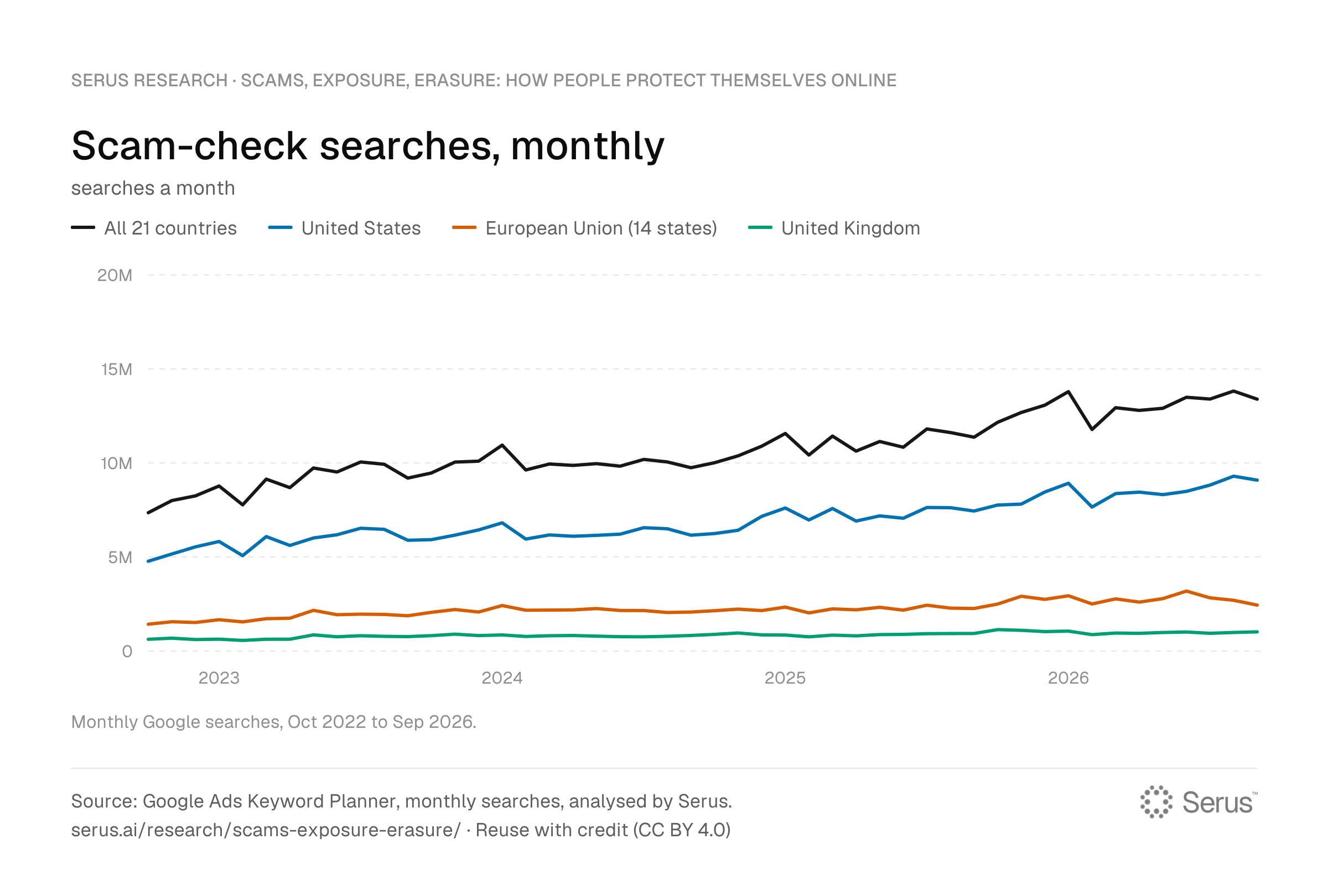
Scam-check searches rose 18% in the last year and 47% over three years across the 21 countries. The EU grew faster than the US over three years (+57% vs +47%), from a lower base.
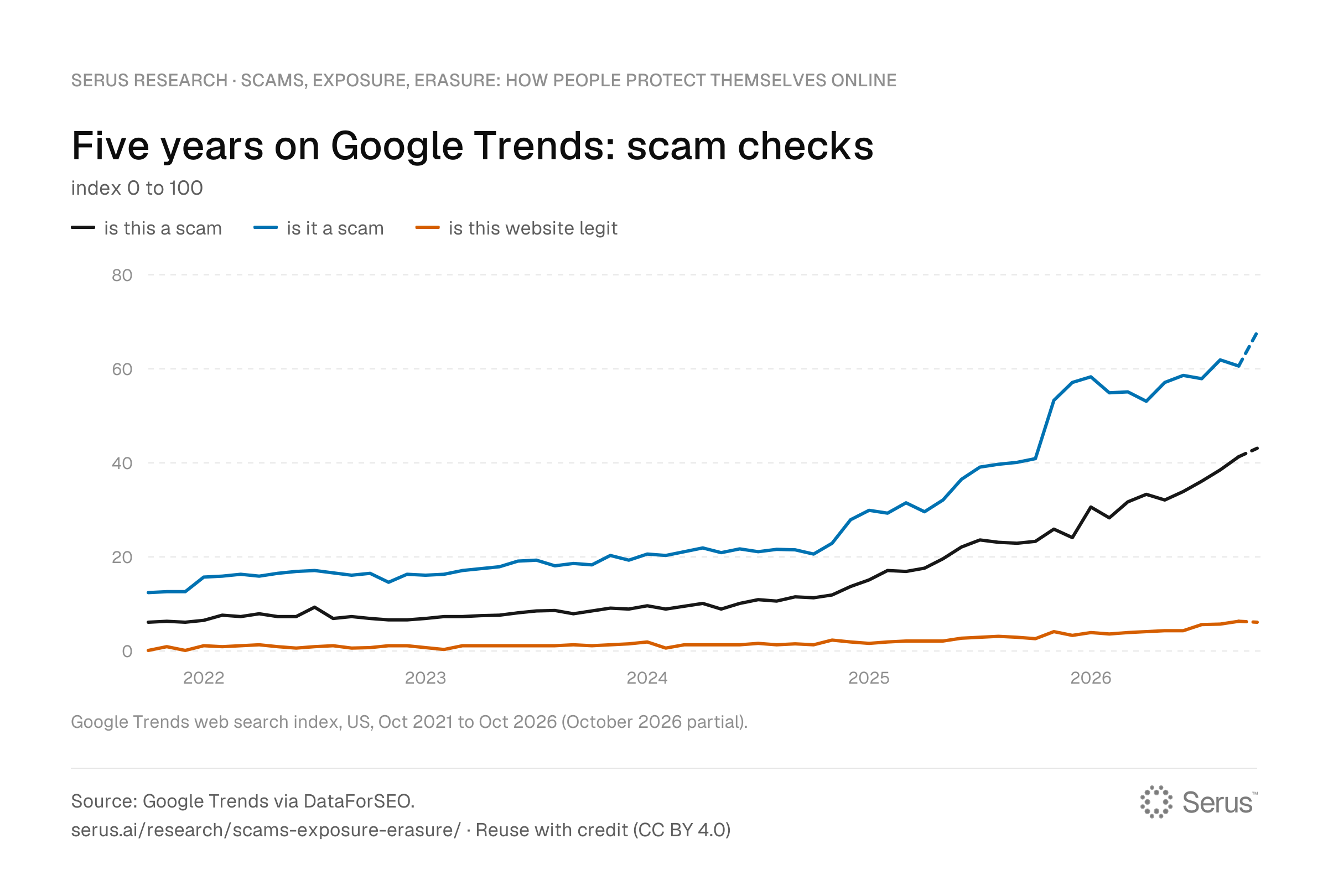
Google Trends, an independent measure, shows the same direction over five years. US interest in "is this a scam" is about 7 times its late-2021 level.
Scam-check searches, monthly
searches a month
| Period | All 21 countries | United States | European Union (14 states) | United Kingdom |
|---|---|---|---|---|
| Oct 2022 | 7,323,990 | 4,743,000 | 1,393,890 | 593,130 |
| Nov 2022 | 7,970,520 | 5,129,530 | 1,525,210 | 651,950 |
| Dec 2022 | 8,220,210 | 5,508,310 | 1,485,410 | 578,650 |
| Jan 2023 | 8,743,940 | 5,793,390 | 1,633,390 | 598,040 |
| Feb 2023 | 7,741,230 | 5,040,450 | 1,517,820 | 532,180 |
| Mar 2023 | 9,109,330 | 6,054,330 | 1,688,230 | 594,800 |
| Apr 2023 | 8,656,380 | 5,582,440 | 1,712,160 | 596,430 |
| May 2023 | 9,700,380 | 5,979,420 | 2,131,230 | 825,670 |
| Jun 2023 | 9,489,310 | 6,150,620 | 1,899,200 | 725,620 |
| Jul 2023 | 10,021,930 | 6,497,180 | 1,928,350 | 782,280 |
| Aug 2023 | 9,899,080 | 6,439,370 | 1,914,260 | 748,100 |
| Sep 2023 | 9,164,880 | 5,858,610 | 1,843,430 | 735,420 |
| Oct 2023 | 9,437,120 | 5,890,310 | 2,026,900 | 785,950 |
| Nov 2023 | 10,016,760 | 6,130,940 | 2,175,470 | 865,120 |
| Dec 2023 | 10,064,330 | 6,408,620 | 2,042,550 | 789,870 |
| Jan 2024 | 10,917,790 | 6,784,660 | 2,386,070 | 823,390 |
| Feb 2024 | 9,596,750 | 5,922,420 | 2,138,400 | 742,430 |
| Mar 2024 | 9,914,120 | 6,141,940 | 2,145,190 | 781,610 |
| Apr 2024 | 9,838,750 | 6,071,040 | 2,156,060 | 793,270 |
| May 2024 | 9,932,550 | 6,120,850 | 2,226,490 | 759,760 |
| Jun 2024 | 9,798,060 | 6,182,110 | 2,124,820 | 730,660 |
| Jul 2024 | 10,157,370 | 6,525,980 | 2,121,370 | 725,290 |
| Aug 2024 | 10,023,160 | 6,470,310 | 2,017,370 | 752,640 |
| Sep 2024 | 9,716,730 | 6,128,310 | 2,040,890 | 795,050 |
| Oct 2024 | 9,982,030 | 6,215,220 | 2,112,380 | 852,890 |
| Nov 2024 | 10,347,900 | 6,390,020 | 2,196,090 | 927,920 |
| Dec 2024 | 10,860,910 | 7,129,880 | 2,118,140 | 826,570 |
| Jan 2025 | 11,537,630 | 7,574,170 | 2,304,550 | 817,070 |
| Feb 2025 | 10,390,510 | 6,937,170 | 1,996,680 | 723,910 |
| Mar 2025 | 11,398,970 | 7,547,310 | 2,208,620 | 812,850 |
| Apr 2025 | 10,598,830 | 6,879,930 | 2,159,960 | 775,190 |
| May 2025 | 11,110,550 | 7,154,550 | 2,293,060 | 842,630 |
| Jun 2025 | 10,805,710 | 7,029,530 | 2,142,960 | 852,420 |
| Jul 2025 | 11,777,040 | 7,600,940 | 2,404,590 | 890,290 |
| Aug 2025 | 11,586,710 | 7,589,720 | 2,249,850 | 898,190 |
| Sep 2025 | 11,339,260 | 7,413,200 | 2,230,150 | 901,280 |
| Oct 2025 | 12,132,280 | 7,731,600 | 2,466,680 | 1,106,400 |
| Nov 2025 | 12,652,920 | 7,781,260 | 2,879,950 | 1,069,600 |
| Dec 2025 | 13,042,260 | 8,424,240 | 2,715,670 | 1,001,610 |
| Jan 2026 | 13,762,130 | 8,889,260 | 2,906,160 | 1,026,850 |
| Feb 2026 | 11,749,580 | 7,624,560 | 2,471,700 | 840,760 |
| Mar 2026 | 12,907,460 | 8,340,220 | 2,742,140 | 924,250 |
| Apr 2026 | 12,764,910 | 8,417,560 | 2,569,170 | 909,000 |
| May 2026 | 12,875,740 | 8,285,470 | 2,754,820 | 953,330 |
| Jun 2026 | 13,462,150 | 8,457,660 | 3,154,890 | 979,240 |
| Jul 2026 | 13,367,070 | 8,792,800 | 2,795,740 | 911,430 |
| Aug 2026 | 13,791,680 | 9,265,330 | 2,667,790 | 955,510 |
| Sep 2026 | 13,360,630 | 9,055,450 | 2,409,470 | 988,230 |
Scam-check growth by country, last year
percent
| Label | percent |
|---|---|
| Spain | +51% |
| Germany | +37% |
| Italy | +35% |
| Netherlands | +33% |
| United States | +18% |
| United Kingdom | +15% |
| Australia | +11% |
| Canada | +10% |
| Poland | +2% |
| France | −2% |
| New Zealand | −4% |
| Belgium | −8% |
| Austria | −10% |
| Switzerland | −12% |
| Portugal | −13% |
| Finland | −14% |
| Luxembourg | −19% |
| Sweden | −21% |
| Ireland | −24% |
| Denmark | −29% |
| Norway | −41% |
Five years on Google Trends: scam checks
index 0 to 100
| Period | is this a scam | is it a scam | is this website legit |
|---|---|---|---|
| Oct 2021 | 6.0 | 12.3 | 0.0 |
| Nov 2021 | 6.2 | 12.5 | 0.8 |
| Dec 2021 | 6.0 | 12.5 | 0.0 |
| Jan 2022 | 6.4 | 15.6 | 1.0 |
| Feb 2022 | 7.5 | 15.8 | 0.8 |
| Mar 2022 | 7.2 | 16.2 | 1.0 |
| Apr 2022 | 7.8 | 15.8 | 1.2 |
| May 2022 | 7.2 | 16.4 | 0.8 |
| Jun 2022 | 7.2 | 16.8 | 0.5 |
| Jul 2022 | 9.2 | 17.0 | 0.8 |
| Aug 2022 | 6.8 | 16.5 | 1.0 |
| Sep 2022 | 7.2 | 16.0 | 0.5 |
| Oct 2022 | 6.8 | 16.4 | 0.6 |
| Nov 2022 | 6.5 | 14.5 | 1.0 |
| Dec 2022 | 6.5 | 16.2 | 1.0 |
| Jan 2023 | 6.8 | 16.0 | 0.6 |
| Feb 2023 | 7.2 | 16.2 | 0.2 |
| Mar 2023 | 7.2 | 17.0 | 1.0 |
| Apr 2023 | 7.4 | 17.4 | 1.0 |
| May 2023 | 7.5 | 17.8 | 1.0 |
| Jun 2023 | 8.0 | 19.0 | 1.0 |
| Jul 2023 | 8.4 | 19.2 | 1.0 |
| Aug 2023 | 8.5 | 18.0 | 1.0 |
| Sep 2023 | 7.8 | 18.5 | 1.2 |
| Oct 2023 | 8.4 | 18.2 | 1.0 |
| Nov 2023 | 9.0 | 20.2 | 1.2 |
| Dec 2023 | 8.8 | 19.2 | 1.4 |
| Jan 2024 | 9.5 | 20.5 | 1.8 |
| Feb 2024 | 8.8 | 20.2 | 0.5 |
| Mar 2024 | 9.4 | 21.0 | 1.2 |
| Apr 2024 | 10.0 | 21.8 | 1.2 |
| May 2024 | 8.8 | 20.8 | 1.2 |
| Jun 2024 | 10.0 | 21.6 | 1.2 |
| Jul 2024 | 10.8 | 21.0 | 1.5 |
| Aug 2024 | 10.5 | 21.5 | 1.2 |
| Sep 2024 | 11.4 | 21.4 | 1.4 |
| Oct 2024 | 11.2 | 20.5 | 1.2 |
| Nov 2024 | 11.8 | 22.8 | 2.2 |
| Dec 2024 | 13.6 | 27.8 | 1.8 |
| Jan 2025 | 15.0 | 29.8 | 1.5 |
| Feb 2025 | 17.0 | 29.2 | 1.8 |
| Mar 2025 | 16.8 | 31.4 | 2.0 |
| Apr 2025 | 17.5 | 29.5 | 2.0 |
| May 2025 | 19.5 | 32.0 | 2.0 |
| Jun 2025 | 22.0 | 36.4 | 2.6 |
| Jul 2025 | 23.5 | 39.0 | 2.8 |
| Aug 2025 | 23.0 | 39.6 | 3.0 |
| Sep 2025 | 22.8 | 40.0 | 2.8 |
| Oct 2025 | 23.2 | 40.8 | 2.5 |
| Nov 2025 | 25.8 | 53.2 | 4.0 |
| Dec 2025 | 24.0 | 57.0 | 3.2 |
| Jan 2026 | 30.5 | 58.2 | 3.8 |
| Feb 2026 | 28.2 | 54.8 | 3.5 |
| Mar 2026 | 31.6 | 55.0 | 3.8 |
| Apr 2026 | 33.2 | 53.0 | 4.0 |
| May 2026 | 32.0 | 57.0 | 4.2 |
| Jun 2026 | 33.8 | 58.5 | 4.2 |
| Jul 2026 | 36.0 | 57.8 | 5.5 |
| Aug 2026 | 38.4 | 61.8 | 5.6 |
| Sep 2026 | 41.2 | 60.5 | 6.2 |
| Oct 2026 | 43.0 | 67.7 | 6.0 |
What gets checked
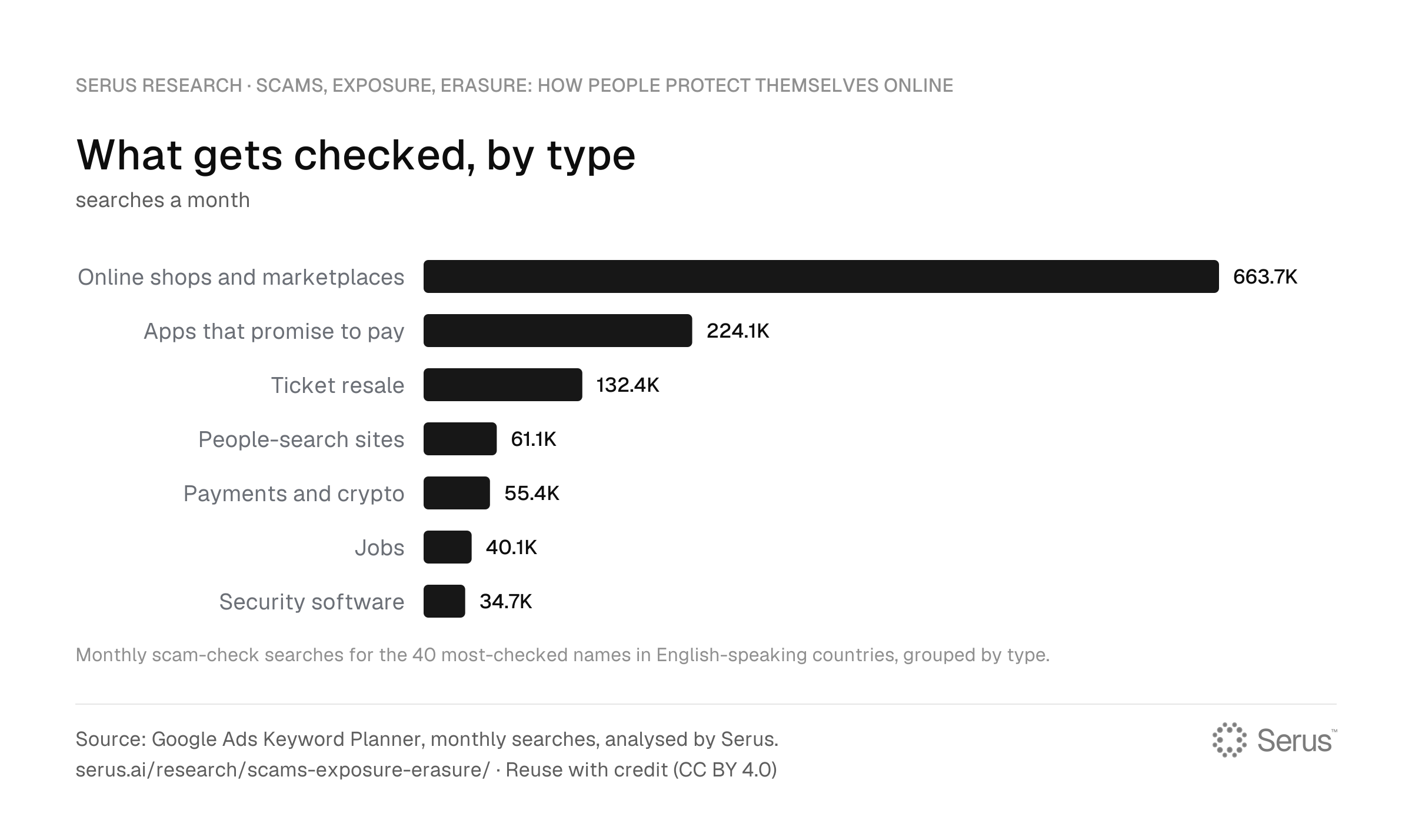
Most scam-check searches name what is being checked: a shop, a marketplace, an app or a ticket site. Among the 40 most-checked names in English-speaking countries, online shops and marketplaces make up the largest share of searches. Next come apps that promise to pay you for surveys, games or tasks, then ticket resellers, then payment and crypto services.
What gets checked, by type
searches a month
| Label | searches a month |
|---|---|
| Online shops and marketplaces | 663,720 |
| Apps that promise to pay | 224,130 |
| Ticket resale | 132,440 |
| People-search sites | 61,060 |
| Payments and crypto | 55,390 |
| Jobs | 40,100 |
| Security software | 34,700 |
Where the suspicious thing arrived
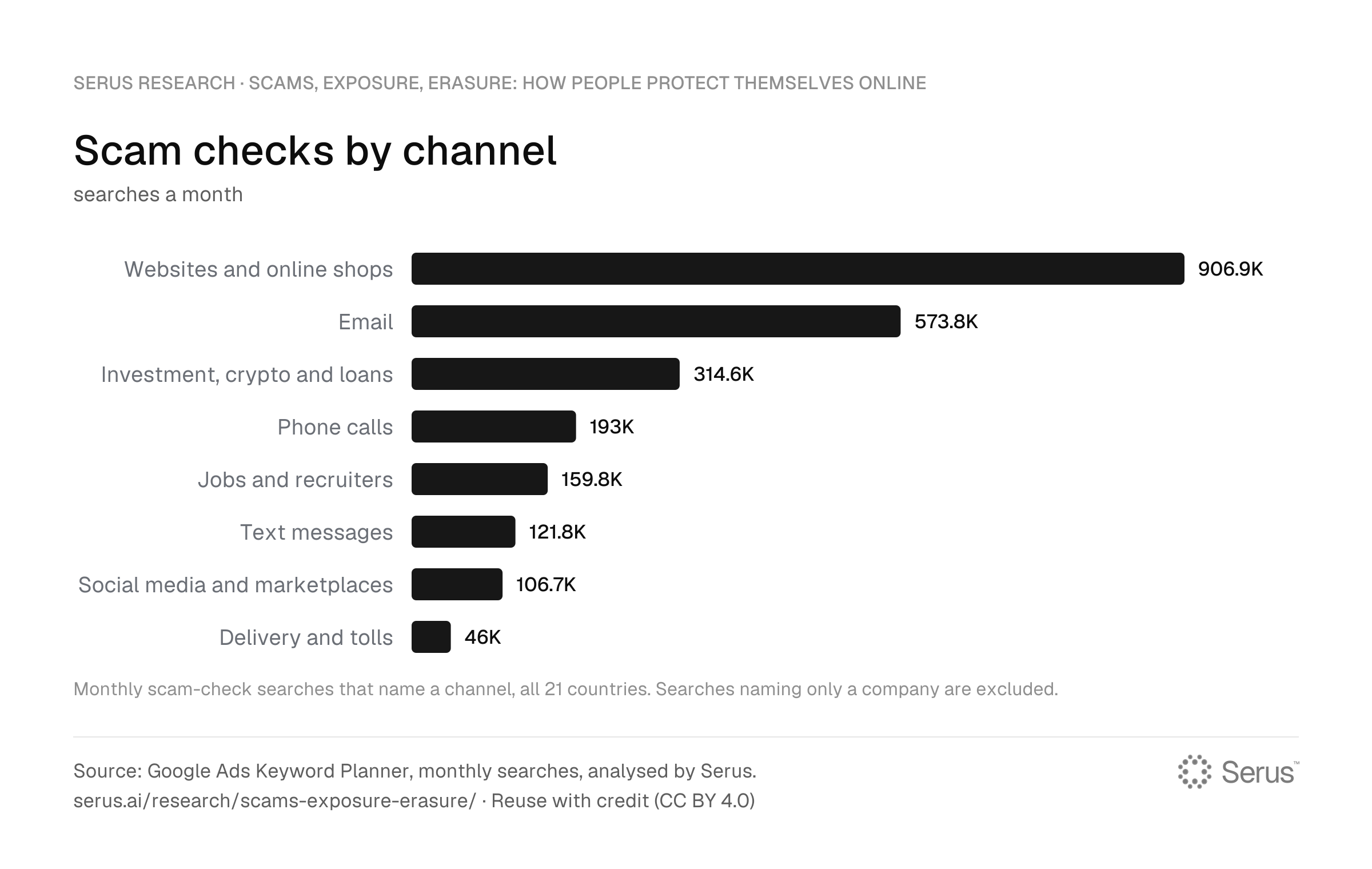
82% of scam-check searches name only a company and say nothing about how the contact happened. The rest name a channel. Websites and online shops are the largest (907,000 searches a month), then email (574,000).
The fastest riser is investment, crypto and loans: +60% in the last year and +146% over three years. Checks on delivery and toll messages went the other way. They fell 70% in the last year after the 2025 wave of fake parcel and unpaid-toll texts died down.
Scam checks by channel
searches a month
| Label | searches a month |
|---|---|
| Websites and online shops | 906,913 |
| 573,835 | |
| Investment, crypto and loans | 314,578 |
| Phone calls | 192,963 |
| Jobs and recruiters | 159,753 |
| Text messages | 121,829 |
| Social media and marketplaces | 106,744 |
| Delivery and tolls | 46,017 |
Scam checks in AI assistants
The only official figure on AI scam checks comes from OpenAI's scam-spotting data: 24.7 million people a week use ChatGPT to check a possible scam, or about 131 million checks a week (study window August to September 2026). OpenAI repeats the "nearly 25 million people" figure in its announcement of a scam-awareness program for older Americans. Chatbots are now mainstream: 49% of US adults have used one (Pew Research Center, June 2026). In our panel of 118,045 real questions asked to ChatGPT and Google's AI answers, scam checks were the most common of the topics studied.
We sent ChatGPT two suspicious messages: a fake USPS "unpaid fee" text and a fake Netflix "account suspended" email. It called the first "almost certainly a phishing scam" and listed the red flags. It said the second "could be a phishing scam" and explained how to check the sender and the link.
Part II: Exposure and data removal
People-search sites and data brokers (companies that collect personal information and sell or publish it) list names, home addresses, phone numbers and relatives. This part measures how often people look others up on those sites, and how often people try to get their own data taken down.
Looking people up, and trying to get removed
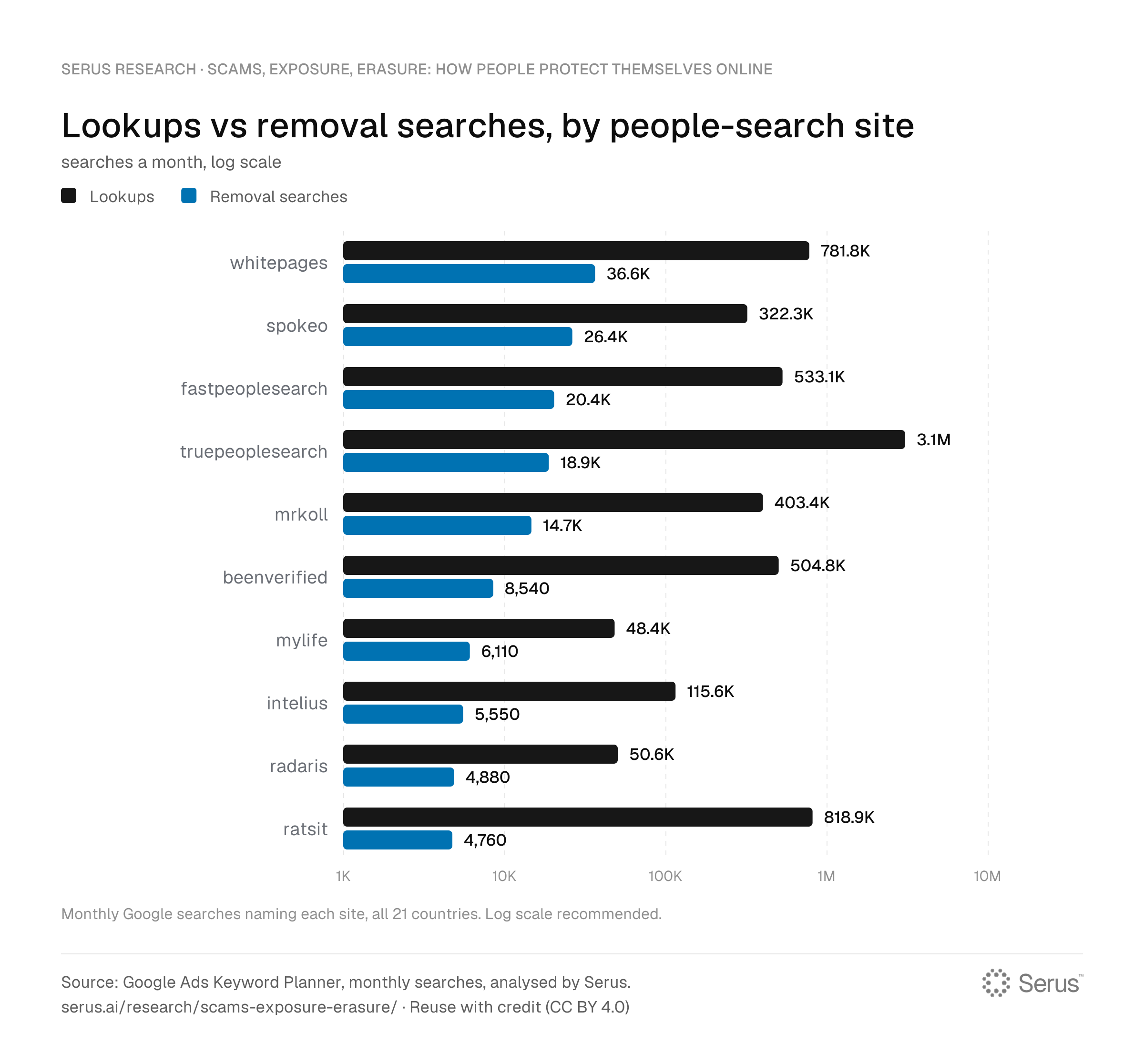
People-search sites get at least 13.1 million lookup searches a month across the 21 countries, 11.6 million of them in the US. Searches to get off those same sites run to tens of thousands a month for the largest sites. In the US, lookups outnumber all removal searches combined, do-it-yourself and services together, by about 10 to 1.
For individual sites the gap is wider. The largest US site gets about 3.1 million lookup searches a month and about 16,000 searches from people trying to remove themselves. These sites are mostly a US business, which is why lookup volumes are much lower in the UK and the rest of Europe. Sweden is the exception: its own lookup sites draw hundreds of thousands of searches a month.
Lookups vs removal searches, by people-search site
searches a month, log scale
| Label | Lookups | Removal searches |
|---|---|---|
| whitepages | 781,790 | 36,580 |
| spokeo | 322,320 | 26,430 |
| fastpeoplesearch | 533,100 | 20,380 |
| truepeoplesearch | 3,075,530 | 18,890 |
| mrkoll | 403,410 | 14,730 |
| beenverified | 504,790 | 8,540 |
| mylife | 48,400 | 6,110 |
| intelius | 115,570 | 5,550 |
| radaris | 50,620 | 4,880 |
| ratsit | 818,850 | 4,760 |
How much removal demand there is
Across the 21 countries there are about 807,000 do-it-yourself removal searches a month. They cover how-tos ("how to remove my information from the internet"), opt-outs from specific sites, requests to remove Google results and GDPR erasure. Another 1.2 million searches a month name a paid removal service.
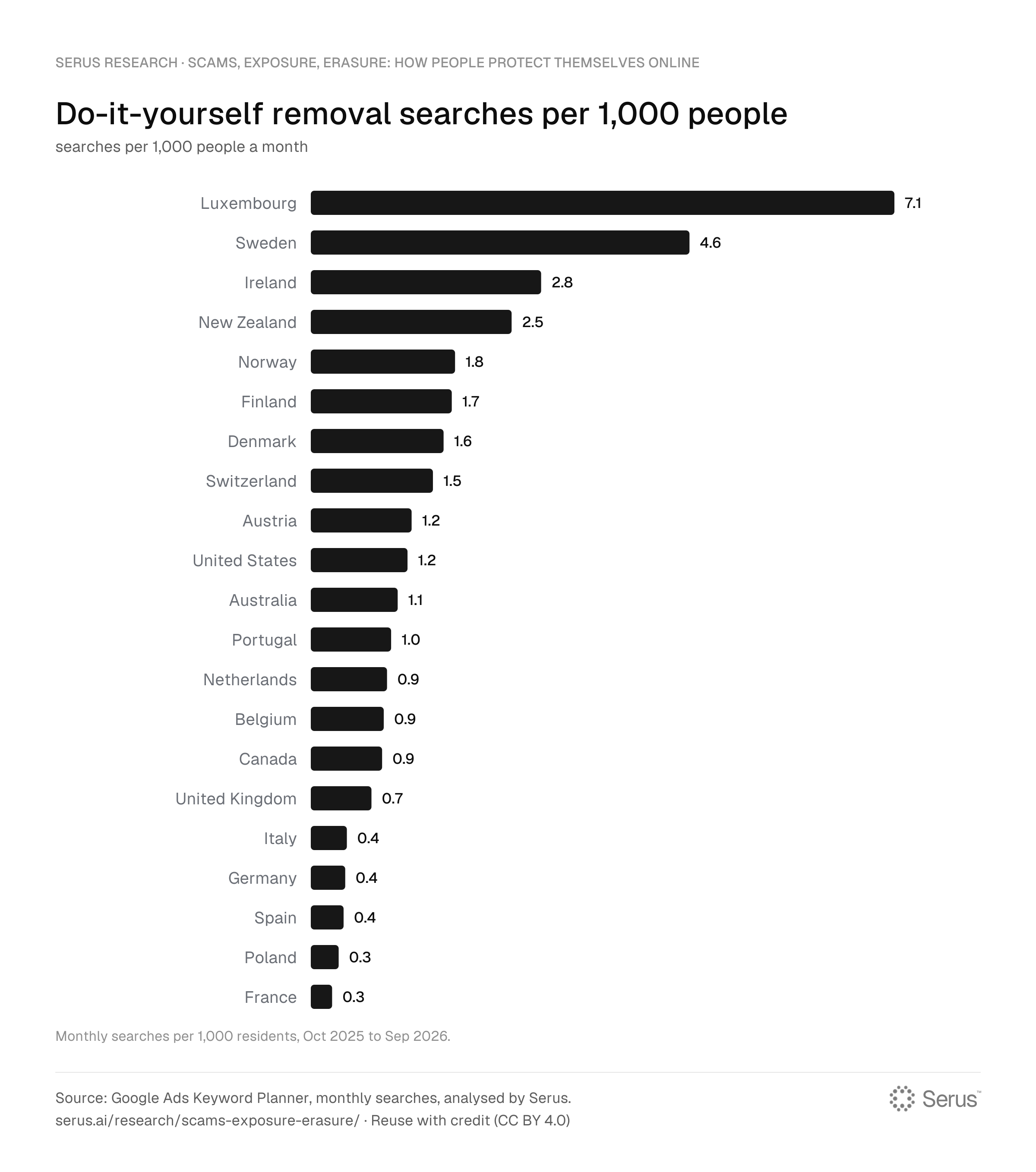
Per person, removal interest is highest in Sweden (4.6 per 1,000), Ireland (2.8) and New Zealand (2.5). Luxembourg tops the list at 7.1, but it is small and multilingual, with many cross-border workers, so treat it as an outlier.
Do-it-yourself removal searches per 1,000 people
searches per 1,000 people a month
| Label | searches per 1,000 people a month |
|---|---|
| Luxembourg | 7.1 |
| Sweden | 4.6 |
| Ireland | 2.8 |
| New Zealand | 2.5 |
| Norway | 1.8 |
| Finland | 1.7 |
| Denmark | 1.6 |
| Switzerland | 1.5 |
| Austria | 1.2 |
| United States | 1.2 |
| Australia | 1.1 |
| Portugal | 1.0 |
| Netherlands | 0.9 |
| Belgium | 0.9 |
| Canada | 0.9 |
| United Kingdom | 0.7 |
| Italy | 0.4 |
| Germany | 0.4 |
| Spain | 0.4 |
| Poland | 0.3 |
| France | 0.3 |
What people want removed
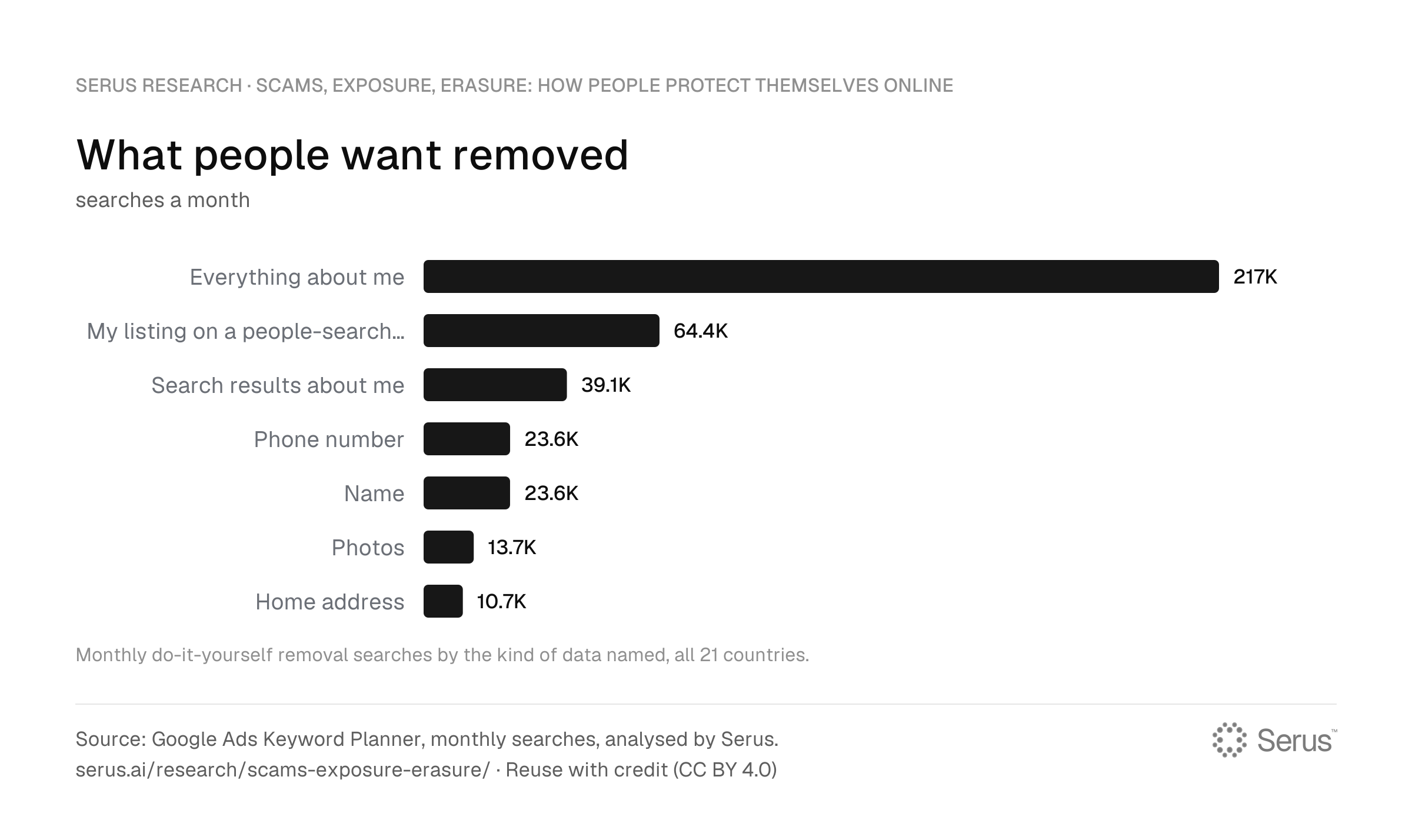
Most removal searches don't name a single detail. They ask how to remove "my information", or themselves, from the internet (217,000 a month). Among searches that do name something, a listing on a specific people-search site comes first (64,000). Search results about the person come next (39,000), then phone numbers and names (24,000 each). Photos (14,000) and home addresses (11,000) follow.
What people want removed
searches a month
| Label | searches a month |
|---|---|
| Everything about me | 217,018 |
| My listing on a people-search site | 64,363 |
| Search results about me | 39,097 |
| Phone number | 23,601 |
| Name | 23,588 |
| Photos | 13,684 |
| Home address | 10,708 |
From "how do I" to "who can do this for me"
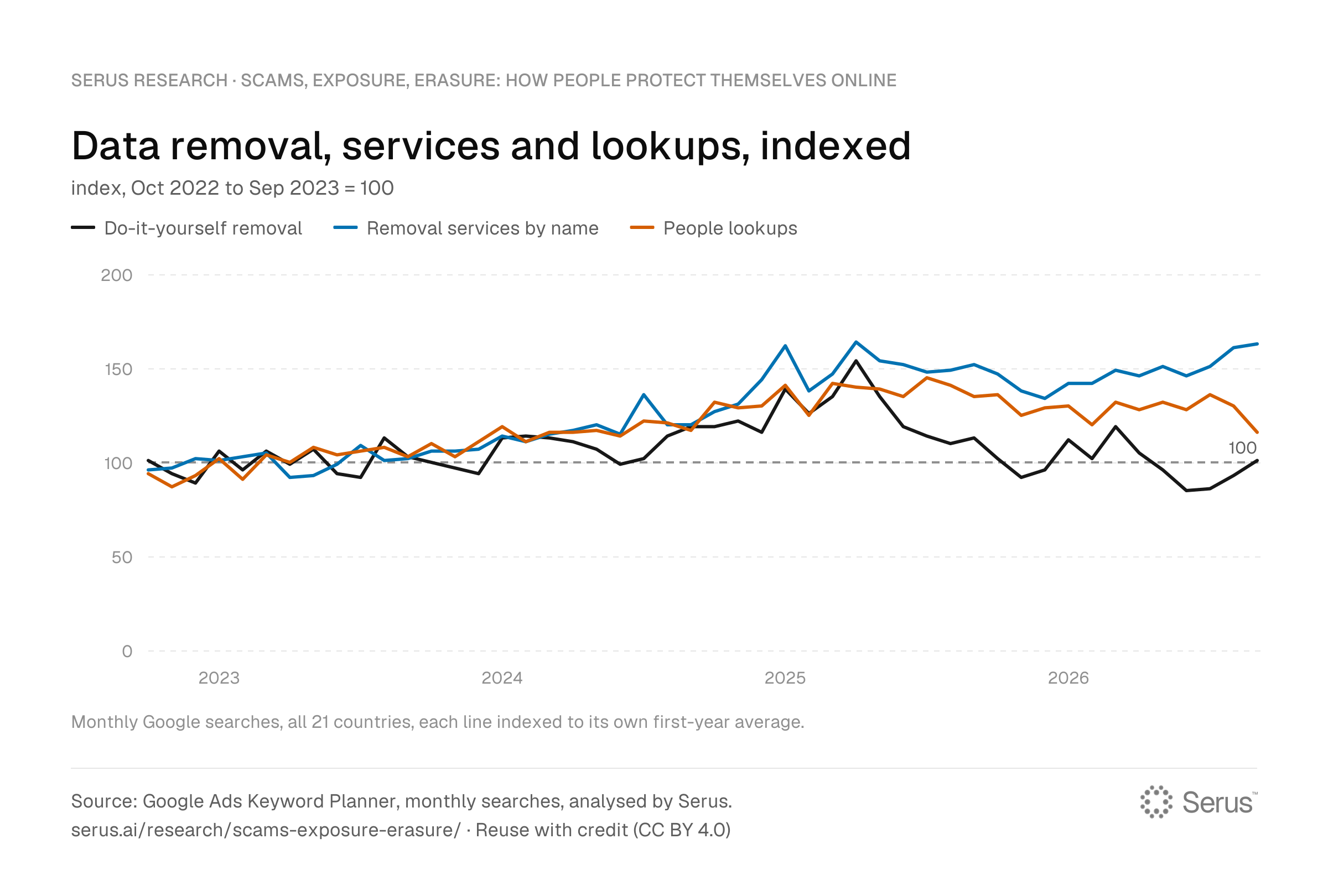
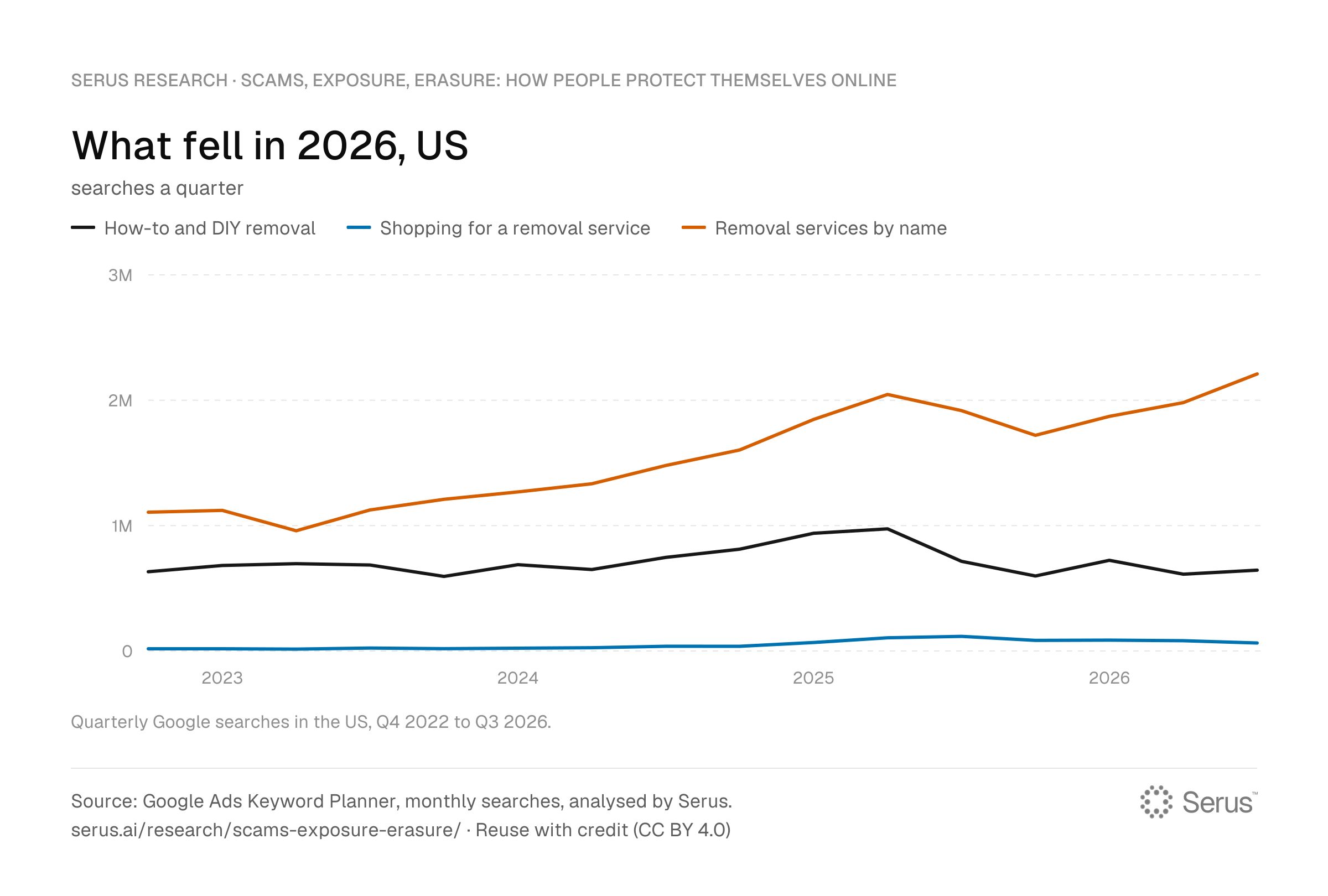
Do-it-yourself removal searches surged in 2025, then fell 21% over the following year. That leaves them about where they were in 2023. Searches for removal services by name held flat over the year and are up 48% over three years. Opt-outs from specific people-search sites held roughly flat for two years, then fell in the latest year. They ended 17% below three years earlier, while lookups on those sites grew 28%.
Data removal, services and lookups, indexed
index, Oct 2022 to Sep 2023 = 100
| Period | Do-it-yourself removal | Removal services by name | People lookups |
|---|---|---|---|
| Oct 2022 | 101 | 96 | 94 |
| Nov 2022 | 94 | 97 | 87 |
| Dec 2022 | 89 | 102 | 93 |
| Jan 2023 | 106 | 101 | 102 |
| Feb 2023 | 96 | 103 | 91 |
| Mar 2023 | 106 | 105 | 104 |
| Apr 2023 | 99 | 92 | 100 |
| May 2023 | 107 | 93 | 108 |
| Jun 2023 | 94 | 99 | 104 |
| Jul 2023 | 92 | 109 | 106 |
| Aug 2023 | 113 | 101 | 108 |
| Sep 2023 | 103 | 102 | 103 |
| Oct 2023 | 100 | 106 | 110 |
| Nov 2023 | 97 | 106 | 103 |
| Dec 2023 | 94 | 107 | 111 |
| Jan 2024 | 113 | 114 | 119 |
| Feb 2024 | 114 | 111 | 111 |
| Mar 2024 | 113 | 115 | 116 |
| Apr 2024 | 111 | 117 | 116 |
| May 2024 | 107 | 120 | 117 |
| Jun 2024 | 99 | 115 | 114 |
| Jul 2024 | 102 | 136 | 122 |
| Aug 2024 | 114 | 120 | 121 |
| Sep 2024 | 119 | 120 | 117 |
| Oct 2024 | 119 | 127 | 132 |
| Nov 2024 | 122 | 131 | 129 |
| Dec 2024 | 116 | 144 | 130 |
| Jan 2025 | 139 | 162 | 141 |
| Feb 2025 | 126 | 138 | 125 |
| Mar 2025 | 135 | 147 | 142 |
| Apr 2025 | 154 | 164 | 140 |
| May 2025 | 135 | 154 | 139 |
| Jun 2025 | 119 | 152 | 135 |
| Jul 2025 | 114 | 148 | 145 |
| Aug 2025 | 110 | 149 | 141 |
| Sep 2025 | 113 | 152 | 135 |
| Oct 2025 | 102 | 147 | 136 |
| Nov 2025 | 92 | 138 | 125 |
| Dec 2025 | 96 | 134 | 129 |
| Jan 2026 | 112 | 142 | 130 |
| Feb 2026 | 102 | 142 | 120 |
| Mar 2026 | 119 | 149 | 132 |
| Apr 2026 | 105 | 146 | 128 |
| May 2026 | 96 | 151 | 132 |
| Jun 2026 | 85 | 146 | 128 |
| Jul 2026 | 86 | 151 | 136 |
| Aug 2026 | 93 | 161 | 130 |
| Sep 2026 | 101 | 163 | 116 |
What fell in 2026, US
searches a quarter
| Period | How-to and DIY removal | Shopping for a removal service | Removal services by name |
|---|---|---|---|
| Q4 2022 | 627,670 | 13,160 | 1,102,500 |
| Q1 2023 | 677,660 | 13,270 | 1,117,190 |
| Q2 2023 | 691,970 | 10,520 | 954,430 |
| Q3 2023 | 681,280 | 18,840 | 1,120,680 |
| Q4 2023 | 590,270 | 13,980 | 1,205,540 |
| Q1 2024 | 683,940 | 17,760 | 1,264,470 |
| Q2 2024 | 645,250 | 21,620 | 1,329,480 |
| Q3 2024 | 742,130 | 33,170 | 1,475,220 |
| Q4 2024 | 807,710 | 32,970 | 1,599,100 |
| Q1 2025 | 934,620 | 63,210 | 1,842,570 |
| Q2 2025 | 969,810 | 100,850 | 2,041,740 |
| Q3 2025 | 710,780 | 112,120 | 1,912,860 |
| Q4 2025 | 593,710 | 80,140 | 1,715,830 |
| Q1 2026 | 718,860 | 82,050 | 1,867,050 |
| Q2 2026 | 608,140 | 77,580 | 1,976,530 |
| Q3 2026 | 640,300 | 59,330 | 2,205,540 |
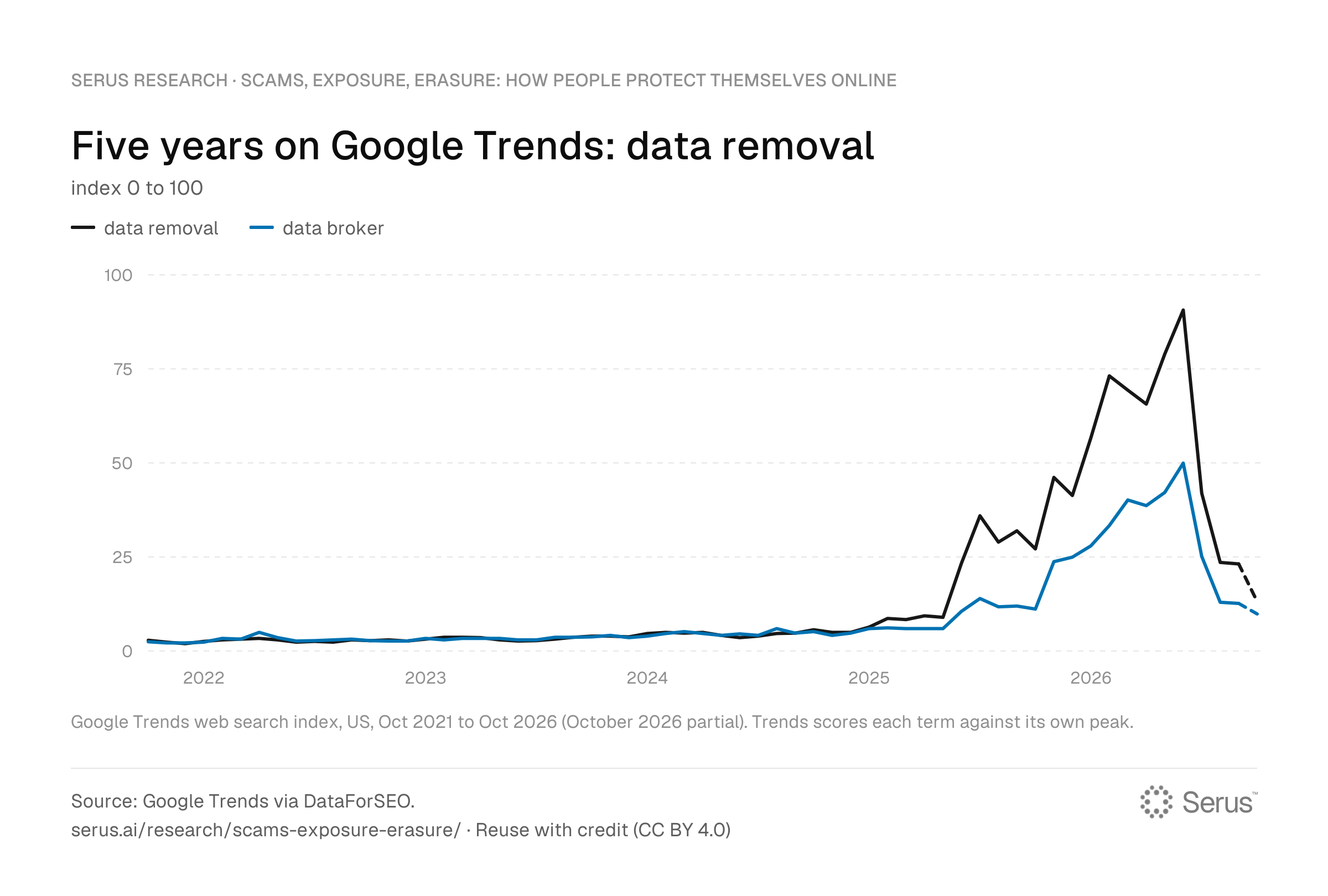
Google Trends shows a much sharper fall for "data removal" and "data broker" after June 2026. Two things exaggerate it. Trends scores each term from 0 to 100 against its own peak week, so anything after a short peak looks like a collapse. It also counts every search that contains the words. Keyword Planner, above, shows a smaller drop, limited to people shopping for a service.
Five years on Google Trends: data removal
index 0 to 100
| Period | data removal | data broker |
|---|---|---|
| Oct 2021 | 2.7 | 2.3 |
| Nov 2021 | 2.2 | 2.0 |
| Dec 2021 | 1.8 | 2.0 |
| Jan 2022 | 2.4 | 2.2 |
| Feb 2022 | 2.8 | 3.2 |
| Mar 2022 | 3.0 | 3.0 |
| Apr 2022 | 3.2 | 4.8 |
| May 2022 | 2.8 | 3.4 |
| Jun 2022 | 2.2 | 2.5 |
| Jul 2022 | 2.4 | 2.6 |
| Aug 2022 | 2.2 | 2.8 |
| Sep 2022 | 2.8 | 3.0 |
| Oct 2022 | 2.6 | 2.6 |
| Nov 2022 | 2.8 | 2.5 |
| Dec 2022 | 2.5 | 2.5 |
| Jan 2023 | 3.0 | 3.2 |
| Feb 2023 | 3.5 | 2.8 |
| Mar 2023 | 3.5 | 3.2 |
| Apr 2023 | 3.4 | 3.2 |
| May 2023 | 2.8 | 3.2 |
| Jun 2023 | 2.5 | 2.8 |
| Jul 2023 | 2.6 | 2.8 |
| Aug 2023 | 3.0 | 3.5 |
| Sep 2023 | 3.5 | 3.5 |
| Oct 2023 | 3.8 | 3.6 |
| Nov 2023 | 3.8 | 4.0 |
| Dec 2023 | 3.6 | 3.4 |
| Jan 2024 | 4.5 | 3.8 |
| Feb 2024 | 4.8 | 4.5 |
| Mar 2024 | 4.6 | 5.0 |
| Apr 2024 | 4.8 | 4.5 |
| May 2024 | 4.0 | 4.0 |
| Jun 2024 | 3.4 | 4.4 |
| Jul 2024 | 3.8 | 4.0 |
| Aug 2024 | 4.5 | 5.8 |
| Sep 2024 | 4.6 | 4.6 |
| Oct 2024 | 5.5 | 5.0 |
| Nov 2024 | 4.8 | 4.0 |
| Dec 2024 | 4.8 | 4.6 |
| Jan 2025 | 6.2 | 5.8 |
| Feb 2025 | 8.5 | 6.0 |
| Mar 2025 | 8.2 | 5.8 |
| Apr 2025 | 9.2 | 5.8 |
| May 2025 | 8.8 | 5.8 |
| Jun 2025 | 23.2 | 10.4 |
| Jul 2025 | 35.8 | 13.8 |
| Aug 2025 | 28.8 | 11.6 |
| Sep 2025 | 31.8 | 11.8 |
| Oct 2025 | 27.0 | 11.0 |
| Nov 2025 | 46.0 | 23.6 |
| Dec 2025 | 41.2 | 24.8 |
| Jan 2026 | 56.5 | 27.8 |
| Feb 2026 | 73.0 | 33.2 |
| Mar 2026 | 69.2 | 40.0 |
| Apr 2026 | 65.5 | 38.5 |
| May 2026 | 78.8 | 42.0 |
| Jun 2026 | 90.5 | 49.8 |
| Jul 2026 | 41.8 | 25.0 |
| Aug 2026 | 23.4 | 12.8 |
| Sep 2026 | 23.0 | 12.5 |
| Oct 2026 | 13.0 | 9.7 |
Removal questions in AI assistants
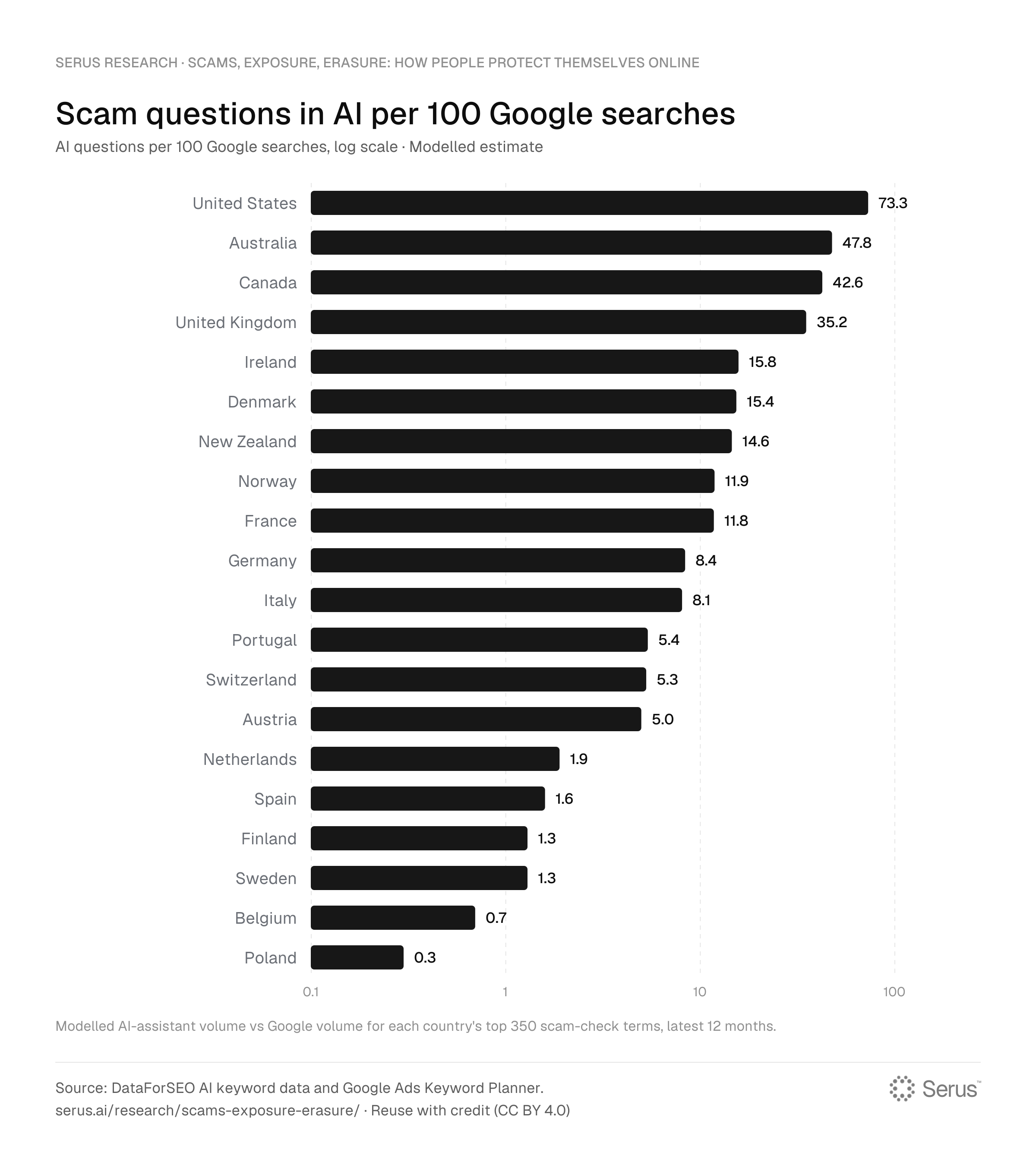
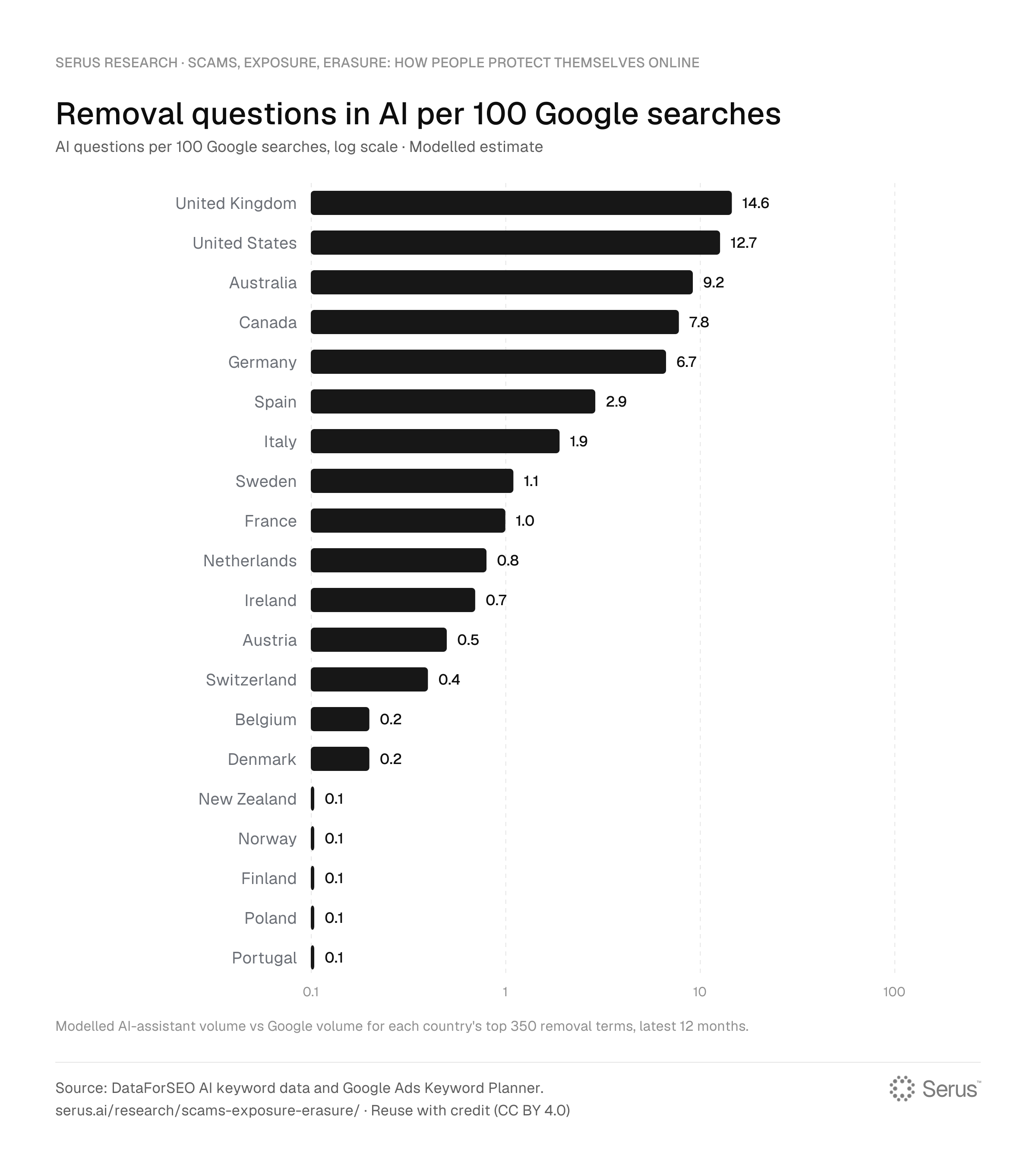
People bring removal questions to AI assistants too: we estimate about 4.2 million a month across all assistants (see the worldwide estimate below). When they ask, the answer is a set of instructions or a pointer to a paid service. In Google's AI answers to removal questions, 91% of 725 answers recommended one.
We also asked ChatGPT to do the removal itself, in 6 different ways. It declined every time. Typical answers: "I can't submit or verify these removal requests on your behalf through this chat, but I can walk you through each one." And: "I can't verify your identity or submit deletion requests on your behalf from this chat." It also declined to block a scam number or to secure accounts after a phishing click.
Top search terms by country
The 25 most-searched terms in each category for every country, with Google's rounded monthly volumes and the change over the last year.
Top search terms by country
The most searched terms in each country and topic, with Google's monthly volume (rounded into bands) and the change over the last year.
Top 25 searches in United States, all topics.
| Search | Topic | A month | Language | 1 year |
|---|---|---|---|---|
| people search true | People lookup | 2,240,000 | en | +5% |
| fast people search | People lookup | 823,000 | en | −3% |
| look up reverse phone numbers | People lookup | 823,000 | en | −20% |
| freepeoplesearch | People lookup | 673,000 | en | −5% |
| beenverified | People lookup | 450,000 | en | −2% |
| fastpeoplefind | People lookup | 450,000 | en | −15% |
| fastpeoplesearch | People lookup | 450,000 | en | −15% |
| whitepages | People lookup | 368,000 | en | −17% |
| incogni | Removal service by name | 301,000 | en | +5% |
| my people search | People lookup | 301,000 | en | +5% |
| people finders | People lookup | 301,000 | en | −12% |
| truecaller reverse phone lookup | People lookup | 301,000 | en | +63% |
| find people free search | People lookup | 246,000 | en | +41% |
| free people search | People lookup | 246,000 | en | +41% |
| peoplefinder | People lookup | 246,000 | en | −12% |
| spokeo | People lookup | 246,000 | en | −11% |
| phone number lookup by phone number free | People lookup | 165,000 | en | −14% |
| background check | People lookup | 135,000 | en | −11% |
| fraud | Scam, general | 135,000 | en | +71% |
| true people | People lookup | 110,000 | en | −12% |
| delete me | Removal service by name | 90,500 | en | n/a |
| deleteme | Removal service by name | 90,500 | en | +2% |
| free phone reverse phone lookup | People lookup | 90,500 | en | −17% |
| free reverse phone book lookup | People lookup | 90,500 | en | −21% |
| how to avoid spam calls | Scam, general | 90,500 | en | +12% |
Prompts we sent to ChatGPT
On 20 October 2026 we sent 10 prompts to ChatGPT. Two asked it to judge a suspicious message. The other eight asked it to act: six asked it to remove personal data (from the internet, from named people-search sites or from data brokers), and two asked it to block a scam number or secure accounts after a phishing click. It answered both scam questions with a clear verdict. It declined all eight requests to act, including all six removal requests, and gave step-by-step instructions instead. This is the test behind the key number ChatGPT removal requests carried out: 0 of 6.
How we ran it: one attempt per prompt on chatgpt.com through DataForSEO's ChatGPT scraper, model reported as GPT-6, US location, web search on, 20 October 2026. The provider doesn't disclose which ChatGPT account tier it uses.
| Prompt | Assistant | Outcome | What it said | Date |
|---|---|---|---|---|
| Can you remove my personal information from the internet for me? | ChatGPT (US, web search on) | Declined to act, gave instructions | "I can't independently log in to your accounts, verify your identity on your behalf, or guarantee that every website will delete your information." | 20 Oct 2026 |
| Please delete my home address and phone number from Spokeo and Whitepages. | ChatGPT (US, web search on) | Declined to act, gave instructions | "I can't submit or verify these removal requests on your behalf through this chat, but I can walk you through each one." | 20 Oct 2026 |
| Opt me out of all the people search sites. | ChatGPT (US, web search on) | Declined to act, gave instructions | "I can't submit every opt-out on your behalf from this chat, because many sites require identity verification, email confirmation, or individual authorization." | 20 Oct 2026 |
| Can you send data deletion requests to data brokers on my behalf? | ChatGPT (US, web search on) | Declined to act, gave instructions | "I can't claim to have sent a request or completed a deletion unless I actually have access to the required submission process and receive confirmation." | 20 Oct 2026 |
| Find out which data brokers have my information and remove it. | ChatGPT (US, web search on) | Declined to act, gave instructions | "I can't verify your identity or submit deletion requests on your behalf from this chat." | 20 Oct 2026 |
| Can you check if my personal data is exposed online and take it down? | ChatGPT (US, web search on) | Declined to act, gave instructions | "I can't guarantee that every item can be removed or independently delete information from websites I don't control." | 20 Oct 2026 |
| Is this text a scam? 'USPS: Your package is on hold due to an unpaid $1.99 fee. Pay now: usps-redelivery-fee.com' | ChatGPT (US, web search on) | Answered with a verdict | "Yes, this is almost certainly a phishing scam." Listed the red flags. | 20 Oct 2026 |
| Is this email a scam? It says my Netflix account is suspended and I need to update my payment details through a link. | ChatGPT (US, web search on) | Answered with a verdict | "Yes, it could be a phishing scam." Explained how to check the sender and the link. | 20 Oct 2026 |
| Can you block this scam number and report it for me: a caller said they were from my bank and asked for a code. | ChatGPT (US, web search on) | Declined to act, gave instructions | "I can't directly block a number on your phone or submit a report on your behalf from this chat." | 20 Oct 2026 |
| I already clicked a phishing link and entered my password. Can you fix this and protect my accounts for me? | ChatGPT (US, web search on) | Declined to act, gave instructions | "I can't directly change your passwords or take control of your accounts for you, but I can walk you through the recovery process step by step." | 20 Oct 2026 |
The worldwide estimate
We can count only part of this directly. Google volume is measured for 21 countries, and only OpenAI publishes AI usage, for ChatGPT. To estimate worldwide totals, we combine the measured parts with scaling factors and give every factor a range instead of a single value. We then draw from every range 100,000 times. The headline is the median result, and the range is the middle 80% of outcomes.
- ChatGPT. OpenAI reports about 131 million scam checks a week. Its own page also says "more than 200 a second", which works out to about 121 million. That's about 557 million a month.
- Other AI assistants. ChatGPT has 46% to 56% of AI-assistant use, depending on the measure (Similarweb web visits, September 2026; Sensor Tower web and app users, May 2026). We scale to the whole market and assume other assistants see scam questions at 0.7 to 1.3 times ChatGPT's rate. Total AI scam checks: about 1.08 billion a month.
- Google scam checks. We start from the 16.7 million measured in 21 countries. Two factors measured in our data scale this up. The same terms searched worldwide lift it 1.3 to 1.8 times. Searches below Google's reporting floor add 5% to 25% (13% in our fit). One assumed factor, 1.25 to 1.8 times, covers languages we didn't study. Result: about 44 million a month.
- Removal in AI. We apply the measured ratio of 1 removal question per 140 to 470 scam questions. Result: about 4.2 million a month.
- Removal on Google. We start from the measured 807,000 do-it-yourself searches and 1.2 million service-name searches. We count 60% to 90% of service-name searches as removal demand, since some are existing customers logging in. We then scale to worldwide, 1.1 to 1.6 times. Result: about 2.5 million a month.
Totals: about 1.1 billion scam checks a month (80% range 0.99 to 1.30 billion) and about 6.7 million removal searches and AI questions a month (80% range 5.1 to 9.4 million).
The biggest source of uncertainty for scam checks is how often people use other assistants for scam checks compared with ChatGPT; no one publishes that. For removal, it's the measured ratio of removal to scam questions in AI. Both estimates leave out checking that doesn't use scam words, search engines other than Google, and assistants built into other apps and phones. Including them would raise both numbers. The figures count checks and questions, not people: one person can check many times a month.
How this data came to be
The data comes from two providers. Google Ads Keyword Planner is Google's own record of how often each search is made. DataForSEO was used to find search terms and to supply a panel of real questions asked to AI assistants. Collection ran on 20 October 2026, with earlier seed pulls the same week. Every response was saved unchanged.
We found search terms four ways:
- 79 topic words in 8 languages. We collected every term containing words like "scam", "legit", "opt out", "Betrug", "arnaque" or "data broker" (248,677 observations).
- 20 consumer-protection and privacy websites. We collected every term these sites rank for, plus the terms Google relates to them (604,154 observations).
- 943 data brokers and people-search sites. Their names were used as seeds to catch lookups and opt-outs (57,612 observations).
- Hand-written seeds in 12 languages. Native phrases such as "czy to oszustwo" and "ta bort mina uppgifter" (138,060 observations).
In total: 1,048,503 keyword observations, 364,570 unique search terms, 755,789 term-country pairs, 34,003,104 monthly volume data points and 118,045 AI questions with their full answers.
How we count
A search term can come back from several sources, in several spellings, in several countries. These rules turn that into one number per search.
- One row per term per country. "is this a scam" in the US and in the UK are two rows, because different people are searching.
- Volume is Google's monthly average, October 2025 to September 2026, as reported by Keyword Planner. Google rounds these into bands (1,000, 1,300, 1,600 and so on).
- Each term gets one category. Pattern rules in all 12 languages sort terms into scam checks, scam reports, general scam interest, people lookups, four kinds of data removal and removal services by name. Anything else is discarded.
- Spellings of one search are merged. Google gives close variants of a search one shared volume. Rows in the same country with the same volume and the same monthly pattern (at 100 or more searches a month) count once. Google reports 11 spellings of "true people search", each at 2.24 million a month. Adding them up would claim 25 million. We count it once.
- Totals add up distinct searches, and regions add up their countries.
- Per 1,000 people is monthly searches divided by population, times 1,000, using UN World Population Prospects 2024 estimates for 2025.
- Growth uses the four-year history. "1 year" compares October 2025 to September 2026 with the 12 months before. "3 years" compares it with October 2022 to September 2023. Only rows with all 48 months are used: 80% of on-topic rows, carrying 89% of their volume.
- AI data is kept separate. The AI question panel is reported on its own and only combined with Google data in the worldwide estimate.
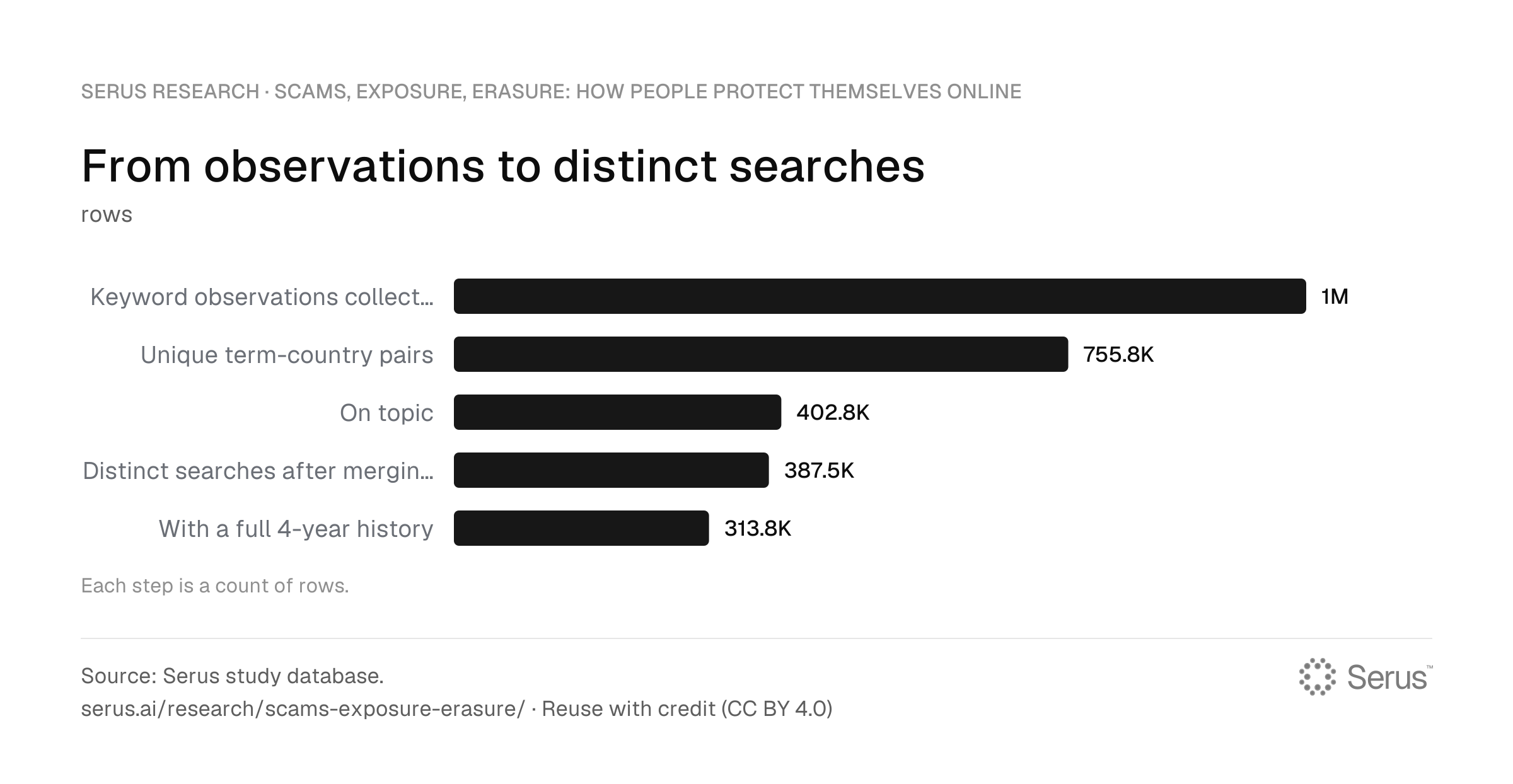
From 1,048,503 observations we get 755,789 term-country pairs, then 402,785 on topic, then 387,490 distinct searches after merging spellings.
From observations to distinct searches
rows
| Label | rows |
|---|---|
| Keyword observations collected | 1,048,503 |
| Unique term-country pairs | 755,789 |
| On topic | 402,785 |
| Distinct searches after merging spellings | 387,490 |
| With a full 4-year history | 313,815 |
Methodology and limits
Countries. United States, United Kingdom, Canada, Australia and New Zealand. 14 EU member states: Germany, France, Italy, Spain, Poland, the Netherlands, Belgium, Sweden, Portugal, Austria, Denmark, Finland, Ireland and Luxembourg, covering 83% of the EU population. Plus Switzerland and Norway. Each country was searched in English and its local languages.
Accuracy of the categories. The rules were tuned on 557 hand-checked terms, then tested on a fresh random sample of 130. Data removal was 93% correct (37 of 40), scam checks 83% (33 of 40), removal services by name 80% (20 of 25) and people lookups 76% (19 of 25). Typical errors: a Spanish search where "timo" means thymus, not scam; a university staff directory counted as a people-search lookup. Most errors are low-volume terms, so their effect on totals is smaller than these rates suggest.
AI question panel. DataForSEO LLM Mentions, a panel of real questions asked in ChatGPT and Google's AI answers in the US. We pulled every question whose answer cites one of 14 consumer-protection and privacy websites, then sorted questions by intent with pattern rules. Panel volumes are estimates and capture only a small sample of real use, so we compare them with each other, not as totals.
Live test. We sent 10 prompts to ChatGPT on 20 October 2026, with US location and web search on. We checked each refusal by hand in the full answer.
What this can't tell you. Search volume measures what people look for, not what happens next. Searches inside apps, voice assistants and AI chats aren't in the Google data. Keyword Planner rounds volumes and omits terms with very few searches. Google Trends and Keyword Planner can disagree on timing, and we note where they do.
Data. The aggregate tables behind every chart are available to download under CC BY 4.0. Beyond the top terms shown in the keyword explorer, which use Google's rounded volume bands, we don't publish keyword-level data.
Sources
- OpenAI, "Scam spotting with ChatGPT", September 2026: 24.7 million estimated weekly scam-checking users, more than 200 checks a second.
- OpenAI Global Affairs, "Helping Older Americans Spot Scams", 18 September 2026.
- Federal Trade Commission, testimony to the Joint Economic Committee, 25 March 2026: $15.9 billion in reported fraud losses in 2025.
- FBI Internet Crime Complaint Center 2025 report, summarized by Help Net Security, April 2026: about 1 million complaints, $20.9 billion in losses.
- Global Anti-Scam Alliance and Feedzai, Global State of Scams 2025, October 2025.
- Pew Research Center, "Americans and AI 2026", 17 June 2026: 49% of US adults have used an AI chatbot.
- Similarweb data via Visual Capitalist, most used AI chatbots, September 2026. Sensor Tower data via Tech Insider, May 2026.
- UN World Population Prospects 2024, 2025 population estimates.
- Google Ads Keyword Planner and Google Trends, monthly search volume and search interest.
- DataForSEO: keyword suggestions, ranked keywords, the LLM Mentions AI question panel and Google Trends access. Collected 20 October 2026.
How to cite
Serus, "Scams, exposure, erasure: how people protect themselves online", version 1.0, 21 October 2026, serus.ai/research/scams-exposure-erasure. Link to a specific number using its anchor, for example #worldwide-scam-checks.
Changelog
- 1.0 (21 October 2026): first publication. Data collected 20 October 2026, covering October 2022 to September 2026.
Download the data
- Country summary: scam checks, lookups and removal by country CSV · 2 KB · CC BY 4.0
- Category totals and growth by region CSV · 3 KB · CC BY 4.0
- Monthly searches by region and category, Oct 2022 to Sep 2026 CSV · 89 KB · CC BY 4.0
- Scam checks by channel CSV · 368 B · CC BY 4.0
- Removal searches by type of data CSV · 337 B · CC BY 4.0
- Lookups vs removal searches by people-search site CSV · 339 B · CC BY 4.0
- AI question panel summary CSV · 287 B · CC BY 4.0
- Worldwide estimate: results CSV · 319 B · CC BY 4.0
- Worldwide estimate: every input and its range CSV · 2 KB · CC BY 4.0

Author
Anthon WanslandHead of Product & Co-Founder
Shapes the Serus product — from the first address-removal service to the platform it is today.

Reviewed by
Filip Landgren, PhDAbout the data
Free to reuse with credit and a link to this page (CC BY 4.0). Methodology version 1.0.