Published
Hacked: who helps you get your account back
A worldwide estimate from 49 countries, and where recovery searches lead. When an account is hacked, most people search for a way back in. We tested where Google, YouTube and four AI assistants send them, read what the results and their comments say, and estimated how often people ask.

Head of Product & Co-Founder

Reviewed by Filip Landgren, PhD
CEO & Co-Founder
Summary
Ask an AI assistant how to get a hacked account back and it sends you to the free fix, the platform's own recovery flow. Ask Google and you usually land somewhere else. Ask YouTube and the comments under the videos sell you a "recovery expert".
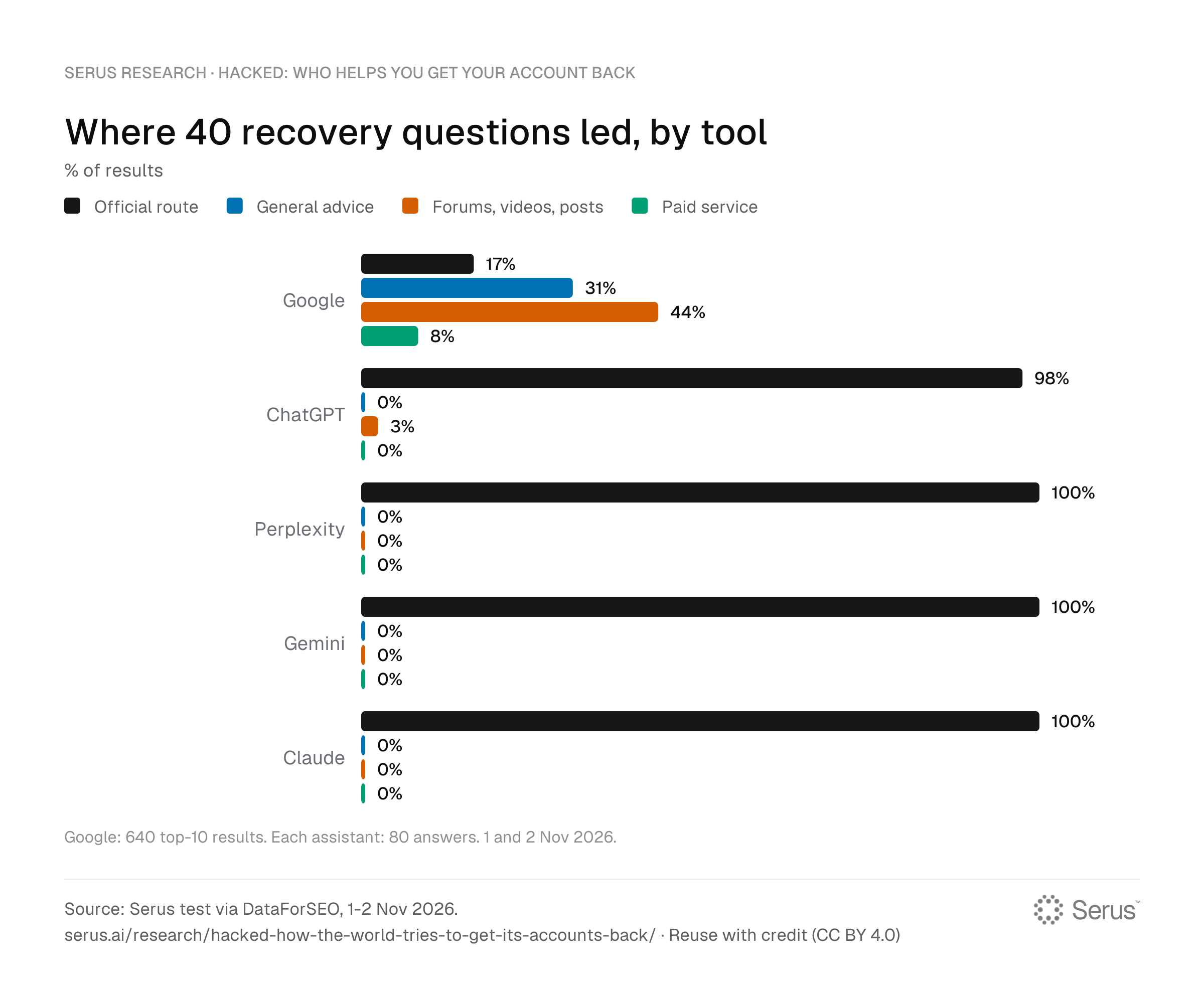
We sent the same 40 recovery questions, in five languages, to Google and four AI assistants on two days. Claude, Gemini and Perplexity pointed to the official route in 100% of answers and ChatGPT in 97.5%. Of Google's top results, 16.6% were the platform's own page. Google's first result was official for 18 of the 80 questions.
YouTube's own search for the same questions returned 981 results in its top 25. 126 of them were videos carrying comments that push a "recovery expert" or a hacker for hire: 874 comments under 83 videos with about 101.1 million views. Most follow a script: "Big thanks [name] for helping me get my account restored."
The stakes are large. People look for help with a hacked account an estimated 38.3 million times a year, and 83.4% of those searches go to Google, not to an assistant. In the US, 22,258 people told the FTC in 2024 that someone had taken over or opened an email or social media account in their name, up 14% on 2023. So most people who lose an account start where the free fix is hardest to find, and on YouTube people are waiting to sell it to them.
What we did
We counted hacked-account searches in 34 languages and 49 countries and modelled the rest. We sent 40 recovery questions in 5 languages to Google, ChatGPT, Gemini, Claude and Perplexity, then to YouTube, and read 28,859 comments.
What we found
Assistants pointed to the free fix in 97.5-100% of answers; 16.6% of Google's top results were official. 126 of 981 YouTube results carried 'recovery expert' pitches, on videos with 101.1 million views. An estimated 38.3 million searches a year.
Key numbers
-
~38.3 million
searches a year
People look for help with a hacked account an estimated 38.3 million times a year on search engines and AI assistants.
Worldwide, search engines and AI assistants (China left out) · Yearly estimate, Oct 2025 to Sep 2026 80% range 34.0 to 41.3 million
How to cite: Serus, “Hacked: who helps you get your account back” (Nov 2026), People look for help with a hacked account an estimated 38.3 million times a year on search engines and AI assistants. https://www.serus.ai/research/hacked-how-the-world-tries-to-get-its-accounts-back/#searches-a-year
-
25.8 million
searches a year
On Google alone we counted 25.8 million hacked-account searches a year in 34 languages.
Worldwide, 34 languages · Oct 2025 to Sep 2026
How to cite: Serus, “Hacked: who helps you get your account back” (Nov 2026), On Google alone we counted 25.8 million hacked-account searches a year in 34 languages. https://www.serus.ai/research/hacked-how-the-world-tries-to-get-its-accounts-back/#google-counted
-
100
% of answers
Claude, Gemini and Perplexity sent people to the platform's own recovery route in 100% of answers; ChatGPT in 97.5%.
5 countries, 5 languages · Test, 1-2 Nov 2026
How to cite: Serus, “Hacked: who helps you get your account back” (Nov 2026), Claude, Gemini and Perplexity sent people to the platform's own recovery route in 100% of answers; ChatGPT in 97.5%. https://www.serus.ai/research/hacked-how-the-world-tries-to-get-its-accounts-back/#ai-official
-
16.6
% of top-10 results
Only 16.6% of Google's top 10 results were the platform's own help or recovery pages.
5 countries, 5 languages · Test, 1-2 Nov 2026
How to cite: Serus, “Hacked: who helps you get your account back” (Nov 2026), Only 16.6% of Google's top 10 results were the platform's own help or recovery pages. https://www.serus.ai/research/hacked-how-the-world-tries-to-get-its-accounts-back/#google-official
-
126
of 981 YouTube results
126 of 981 YouTube top-25 results for the same 40 questions were videos with comments pushing a 'recovery expert' or a hacker for hire.
YouTube, 5 countries, 5 languages · Test, 18 Nov 2026
How to cite: Serus, “Hacked: who helps you get your account back” (Nov 2026), 126 of 981 YouTube top-25 results for the same 40 questions were videos with comments pushing a 'recovery expert' or a hacker for hire. https://www.serus.ai/research/hacked-how-the-world-tries-to-get-its-accounts-back/#youtube-pitch-results
-
22,258
reports
22,258 Americans reported to the FTC in 2024 that someone took over or opened an email or social media account in their name, up 14% on 2023.
United States · 2024
How to cite: Serus, “Hacked: who helps you get your account back” (Nov 2026), 22,258 Americans reported to the FTC in 2024 that someone took over or opened an email or social media account in their name, up 14% on 2023. https://www.serus.ai/research/hacked-how-the-world-tries-to-get-its-accounts-back/#ftc-account-takeovers
-
101.1 million
views
The 83 videos carrying 874 pitch comments have about 101.1 million views.
YouTube, 83 videos · Test, 18 Nov 2026
How to cite: Serus, “Hacked: who helps you get your account back” (Nov 2026), The 83 videos carrying 874 pitch comments have about 101.1 million views. https://www.serus.ai/research/hacked-how-the-world-tries-to-get-its-accounts-back/#youtube-pitch-views
-
1.4 billion
US dollars lost
The FBI's IC3 logged 10,516 recovery-scam complaints in 2025 with about $1.4 billion lost, an upper bound that includes fake recovery of money.
United States · 2025
How to cite: Serus, “Hacked: who helps you get your account back” (Nov 2026), The FBI's IC3 logged 10,516 recovery-scam complaints in 2025 with about $1.4 billion lost, an upper bound that includes fake recovery of money. https://www.serus.ai/research/hacked-how-the-world-tries-to-get-its-accounts-back/#ic3-recovery-scams
-
18
of 80 questions
Google's first result was the official page for 18 of 80 recovery questions.
5 countries, 5 languages · Test, 1-2 Nov 2026
How to cite: Serus, “Hacked: who helps you get your account back” (Nov 2026), Google's first result was the official page for 18 of 80 recovery questions. https://www.serus.ai/research/hacked-how-the-world-tries-to-get-its-accounts-back/#first-result-official
-
5.7
% of top-10 results
For Instagram questions, 5.7% of Google's top 10 results were official.
5 countries, 5 languages · Test, 1-2 Nov 2026
How to cite: Serus, “Hacked: who helps you get your account back” (Nov 2026), For Instagram questions, 5.7% of Google's top 10 results were official. https://www.serus.ai/research/hacked-how-the-world-tries-to-get-its-accounts-back/#instagram-official
-
35,434
reports
Action Fraud received 35,434 reports of hacked social media and email accounts in 2024, up from 22,530 in 2023.
United Kingdom · 2024
How to cite: Serus, “Hacked: who helps you get your account back” (Nov 2026), Action Fraud received 35,434 reports of hacked social media and email accounts in 2024, up from 22,530 in 2023. https://www.serus.ai/research/hacked-how-the-world-tries-to-get-its-accounts-back/#uk-reports-2024
The test: where the answers lead
How we ran it: on 1 and 2 Nov 2026 we sent 40 recovery questions in five languages once a day to Google (Google Search organic top 10 (desktop)), ChatGPT (gpt-6), Perplexity (sonar), Gemini (gemini-3.8-flash) and Claude (claude-sonnet-5-5), from the US, Mexico, Brazil, France and Germany, through DataForSEO, and read every non-official Google result from day one (Google, result page and its comments, read 2 Nov 2026). On 18 Nov we sent the same questions once to YouTube (YouTube search, top 25 by relevance, top 100 comments per video).
| Tool | Results | Official route | General advice | Other | Paid service |
|---|---|---|---|---|---|
| 640 | 16.6% | 31.2% | 43.8% | 8.4% | |
| ChatGPT | 80 | 97.5% | 0% | 2.5% | 0% |
| Perplexity | 80 | 100.0% | 0% | 0% | 0% |
| Gemini | 80 | 100.0% | 0% | 0% | 0% |
| Claude | 80 | 100.0% | 0% | 0% | 0% |
The full logs are downloads: every result and answer and what the pages said.
Where 40 recovery questions led, by tool
% of results
| Label | Official route | General advice | Forums, videos, posts | Paid service |
|---|---|---|---|---|
| 17% | 31% | 44% | 8% | |
| ChatGPT | 98% | 0% | 3% | 0% |
| Perplexity | 100% | 0% | 0% | 0% |
| Gemini | 100% | 0% | 0% | 0% |
| Claude | 100% | 0% | 0% | 0% |
Google's first result is rarely official
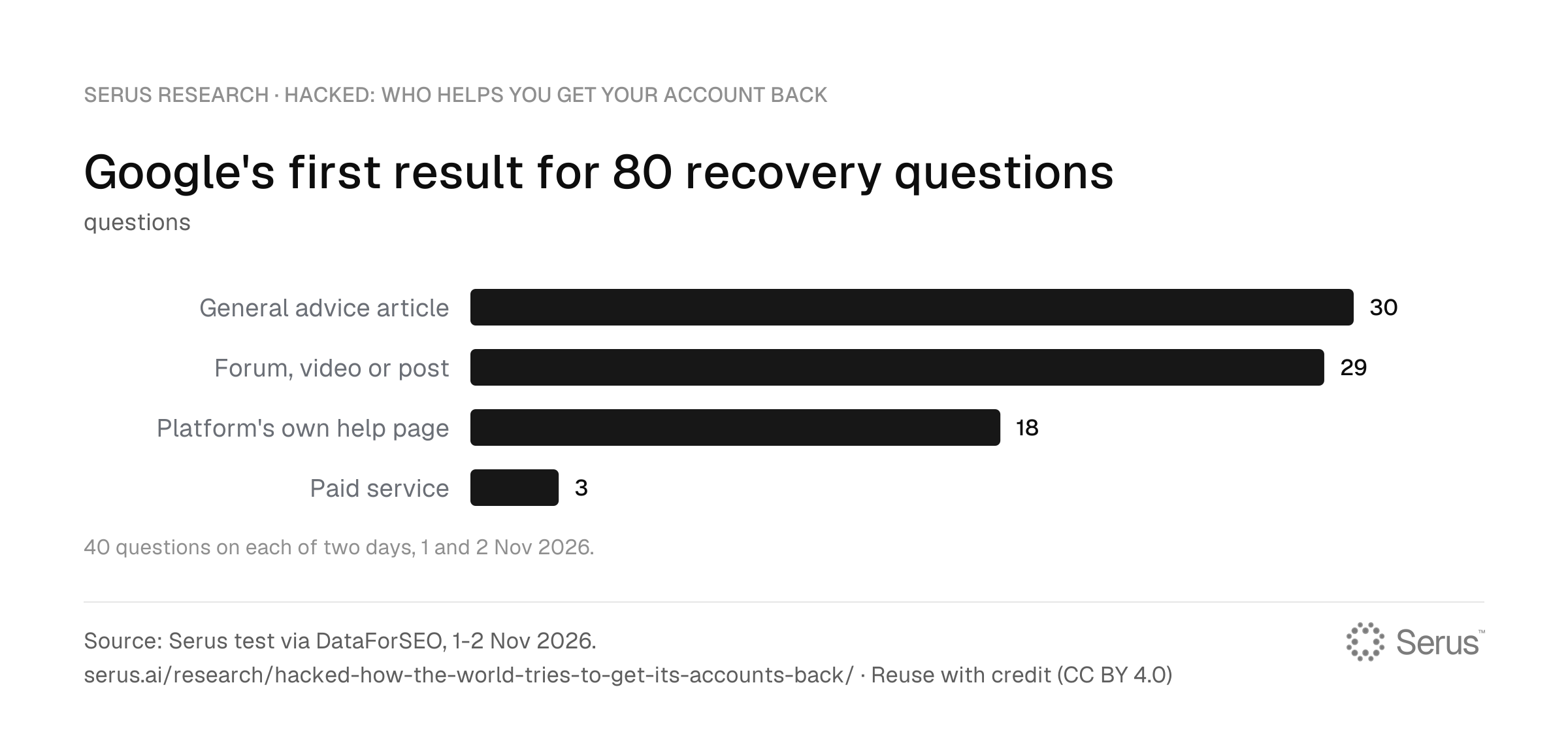
Most people click the first result. Across both days, it was the platform's own help page for 18 of the 80 questions. For 30 it was a general advice article and for 29 a forum thread, video or post. Three times it was a paid service.
Over the full top 10, Reddit (110 results) and YouTube (82) appeared more often than the platforms' own help centres. The official pages exist. They rank below other people's stories.
Google's first result for 80 recovery questions
questions
| Label | questions |
|---|---|
| General advice article | 30 |
| Forum, video or post | 29 |
| Platform's own help page | 18 |
| Paid service | 3 |
Instagram and WhatsApp fare worst
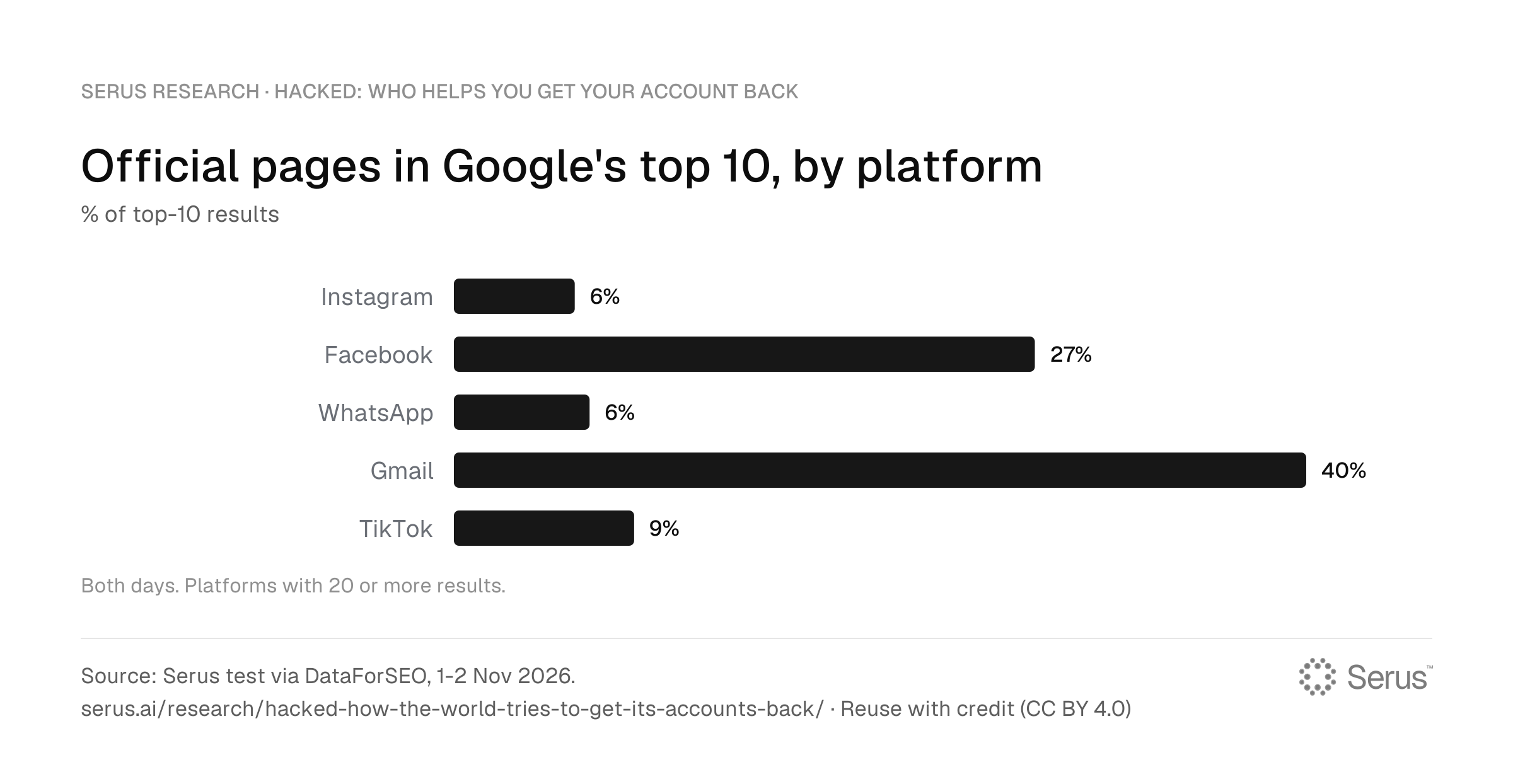
The gap is widest for the platforms people search about most. For Instagram questions, 5.7% of Google's top 10 results were official, and for WhatsApp 6.4%. Gmail did best, mostly because Google ranks its own help pages.
The assistants didn't vary like this. All four sent people to Instagram's and WhatsApp's own recovery routes on both days.
Official pages in Google's top 10, by platform
% of top-10 results
| Label | % of top-10 results |
|---|---|
| 6% | |
| 27% | |
| 6% | |
| Gmail | 40% |
| TikTok | 9% |
Fewer than half point the way back
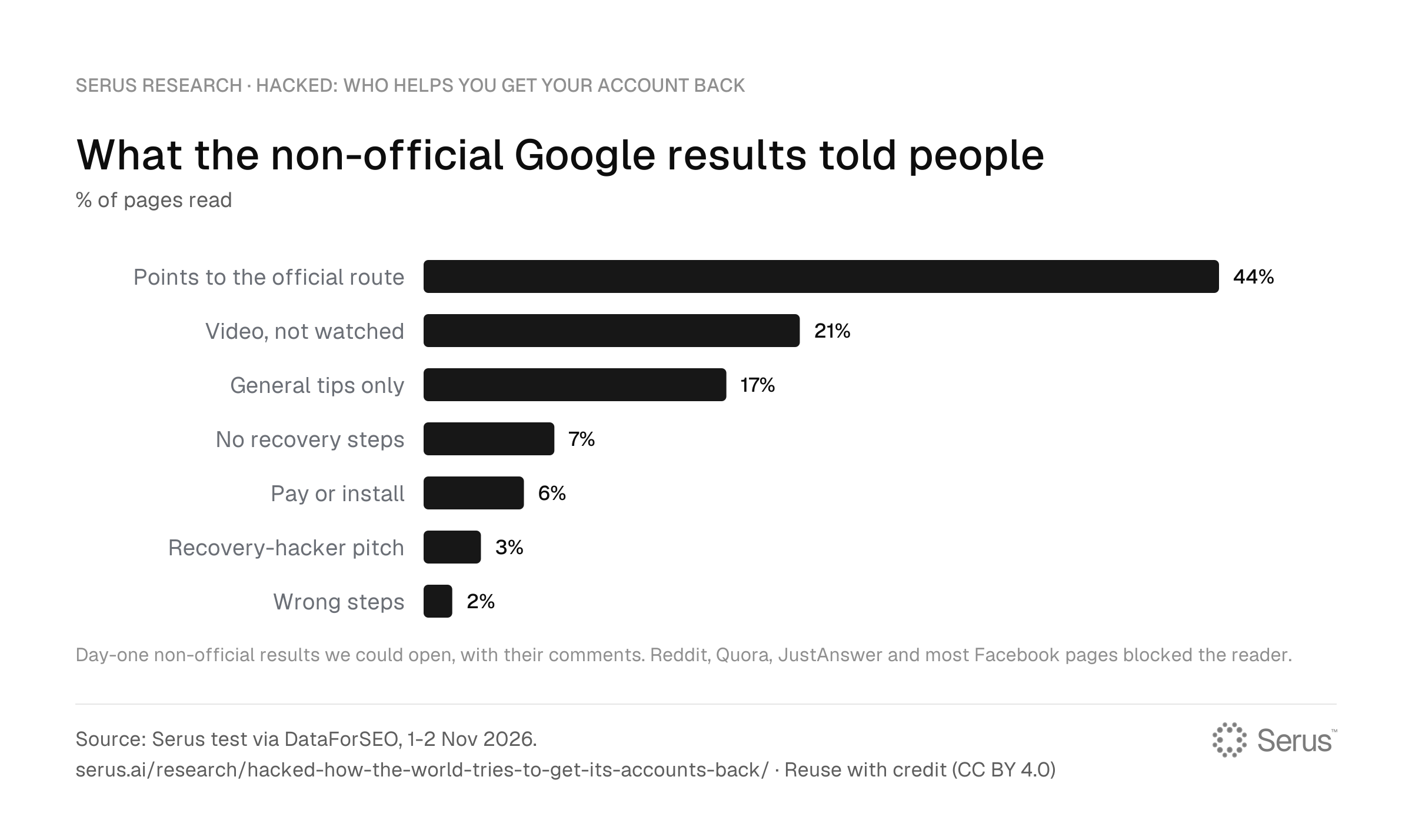
We opened every non-official day-one result and read it, comments included. 124 of the 277 could be read; Reddit, Quora, JustAnswer and most Facebook pages blocked our reader. Of those 124, 44.4% named the platform's recovery flow. Counting them with the official pages, 31.1% of Google's day-one results led to the fix. Another 16.9% gave general tips, like resetting a password, without naming the recovery flow, and 7.3% gave no recovery steps. Our rules look for set phrasings, so a few pages in those two groups do describe the route in other words.
The rest: 5.6% pushed paying a service or installing something, 3.2% pushed an off-platform recovery contact and 1.6% gave wrong steps (emailing an Instagram address that isn't a recovery route). For 21.0%, YouTube videos, we read the description and comments but didn't watch the video.
What the non-official Google results told people
% of pages read
| Label | % of pages read |
|---|---|
| Points to the official route | 44% |
| Video, not watched | 21% |
| General tips only | 17% |
| No recovery steps | 7% |
| Pay or install | 6% |
| Recovery-hacker pitch | 3% |
| Wrong steps | 2% |
Coordinated "thank you" comments
Reading Google's results, we found pitches for off-platform "recovery" contacts on 4 YouTube videos, 33 in all. So we went to YouTube itself.
On 18 Nov 2026 we sent the same 40 questions to YouTube's own search through the YouTube Data API, from the same countries and in the same languages as the Google test, and read the comments under each of the 795 videos, 28,859 in all.
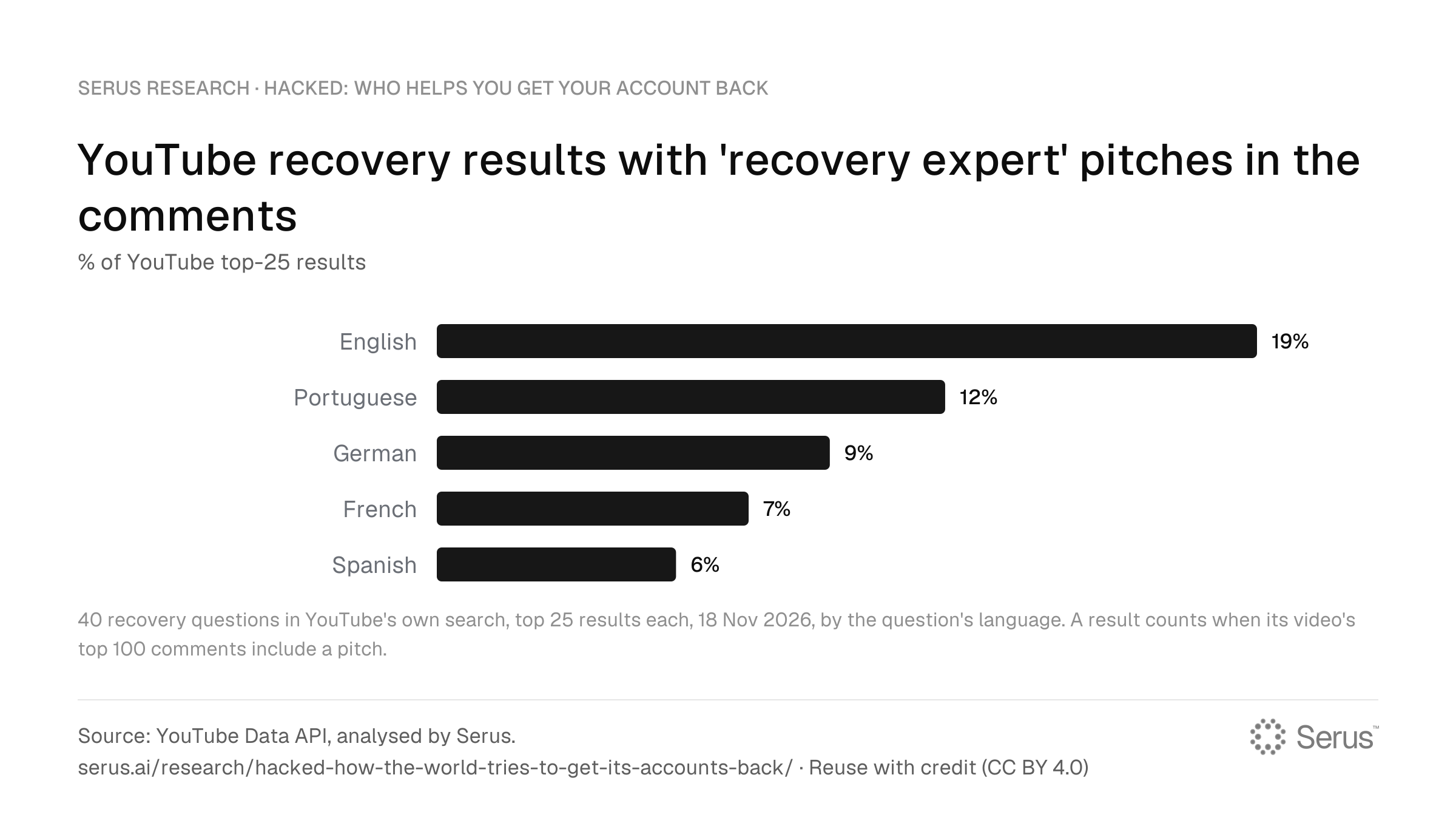
126 of the 981 results, 53 of them in YouTube's top 10, were videos carrying pitches: 874 comments under 83 videos, with about 101.1 million views between them (views of the videos, not of the comments). For English questions, 19.2% of all results did, and for Portuguese 11.9% (shares of all results, including those whose comments we couldn't read). 33 of the 40 questions turned up at least one.
YouTube recovery results with 'recovery expert' pitches in the comments
% of YouTube top-25 results
| Label | % of YouTube top-25 results |
|---|---|
| English | 19% |
| Portuguese | 12% |
| German | 9% |
| French | 7% |
| Spanish | 6% |
| Question language | YouTube results | With pitch comments | Pitch comments |
|---|---|---|---|
| English | 396 | 19.2% | 584 |
| Portuguese | 193 | 11.9% | 61 |
| German | 98 | 9.2% | 148 |
| French | 96 | 7.3% | 37 |
| Spanish | 198 | 5.6% | 44 |
The full log is a download: every YouTube result.
What a lost account costs
Account takeovers are a reported crime. In 2024, 22,258 Americans reported to the FTC that someone had taken over or opened an email or social media account in their name, up 14% on the year before.
The pitches sell a second loss. The FBI's IC3 received 10,516 recovery-scam complaints in 2025, 2,529 of them from people aged 60 and over, with about $1.4 billion lost. That is an upper bound for account recovery: the FBI counts fake recovery of money too, often crypto, and the losses can include the first scam. It's a separate count from the FTC figure for all scams that started on social media in 2023, also about $1.4 billion.
| Reported to | What | Count |
|---|---|---|
| FTC, 2024 | Email or social media account taken over or opened | 22,258 |
| Action Fraud, 2024 | Hacked social media and email accounts | 35,434 |
| FBI IC3, 2025 | Recovery-scam complaints (money and accounts) | 10,516 |
What the paid results were
8.4% of Google's results across both days were paid services. JustAnswer (43 results) sells answers from paid experts. A French law firm charged a flat fee to recover an account, and Relyshield sells account recovery in Spanish, Portuguese and French. None of the AI answers recommended paying anyone.
| Paid result | What it is |
|---|---|
| JustAnswer | Paid expert questions and answers |
| French law firm | Flat fee to recover an account |
| Relyshield | Paid account recovery service |
Who searches
About 38 million searches a year
On Google we counted 25.8 million hacked-account searches a year, in 34 languages. These are victim searches. How-to-hack searches and data breach checks are left out.
That count misses countries and languages we couldn't measure. Applying the rates of the 49 measured countries to every other country's internet users, by income group, puts Google at about 31.9 million.
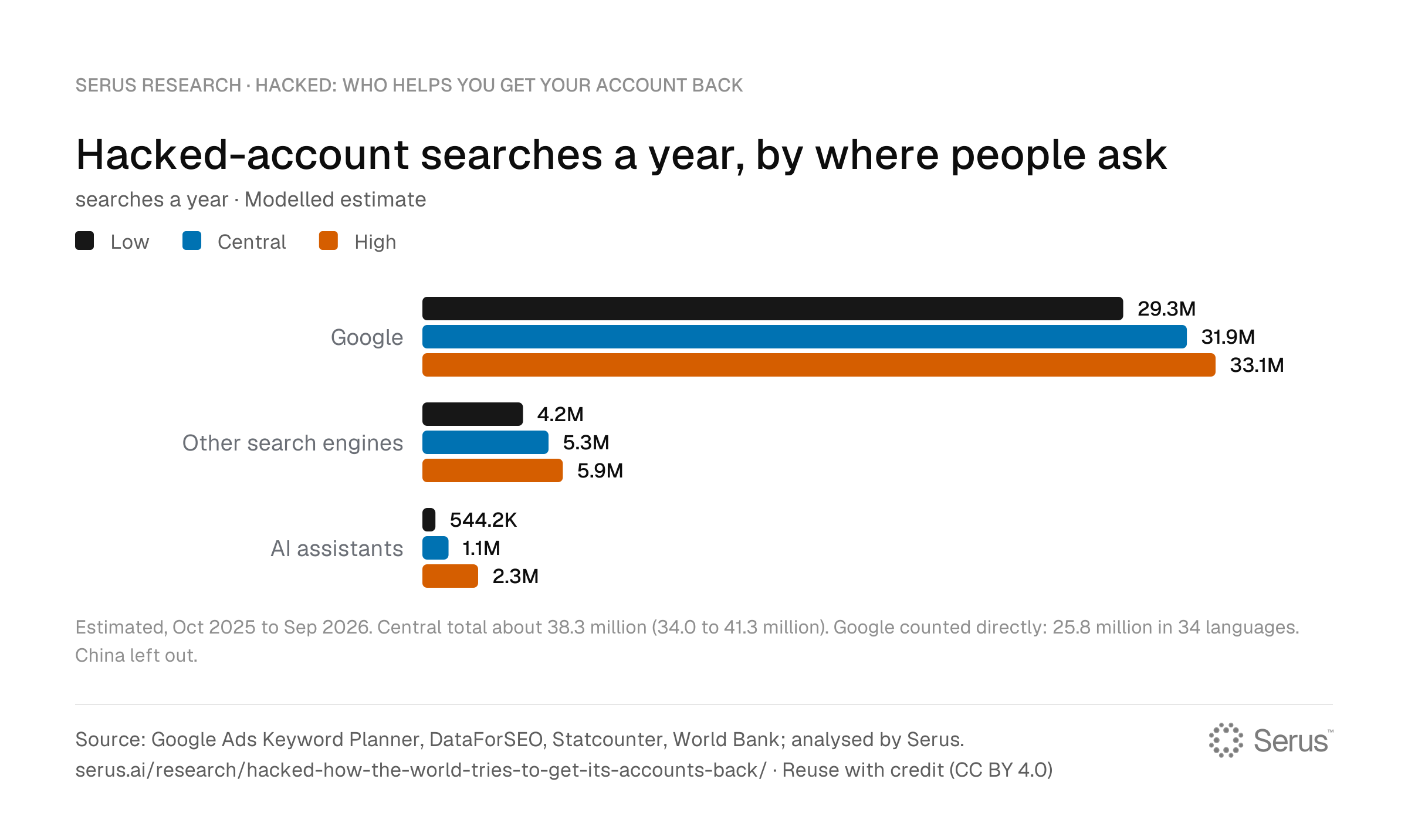
Google isn't everyone's search engine. It handles 26.4% of searches in Russia, 47.8% in South Korea and 64.3% in Japan. Adding other engines by each country's share gives about 5.3 million more, and AI assistants about 1.1 million. Together that's about 38.3 million a year, with a range of 34.0 million to 41.3 million.
Hacked-account searches a year, by where people ask
Modelled estimatesearches a year
| Label | Low | Central | High |
|---|---|---|---|
| 29,271,040 | 31,931,284 | 33,128,959 | |
| Other search engines | 4,201,692 | 5,268,963 | 5,865,915 |
| AI assistants | 544,202 | 1,091,647 | 2,327,300 |
India searches most
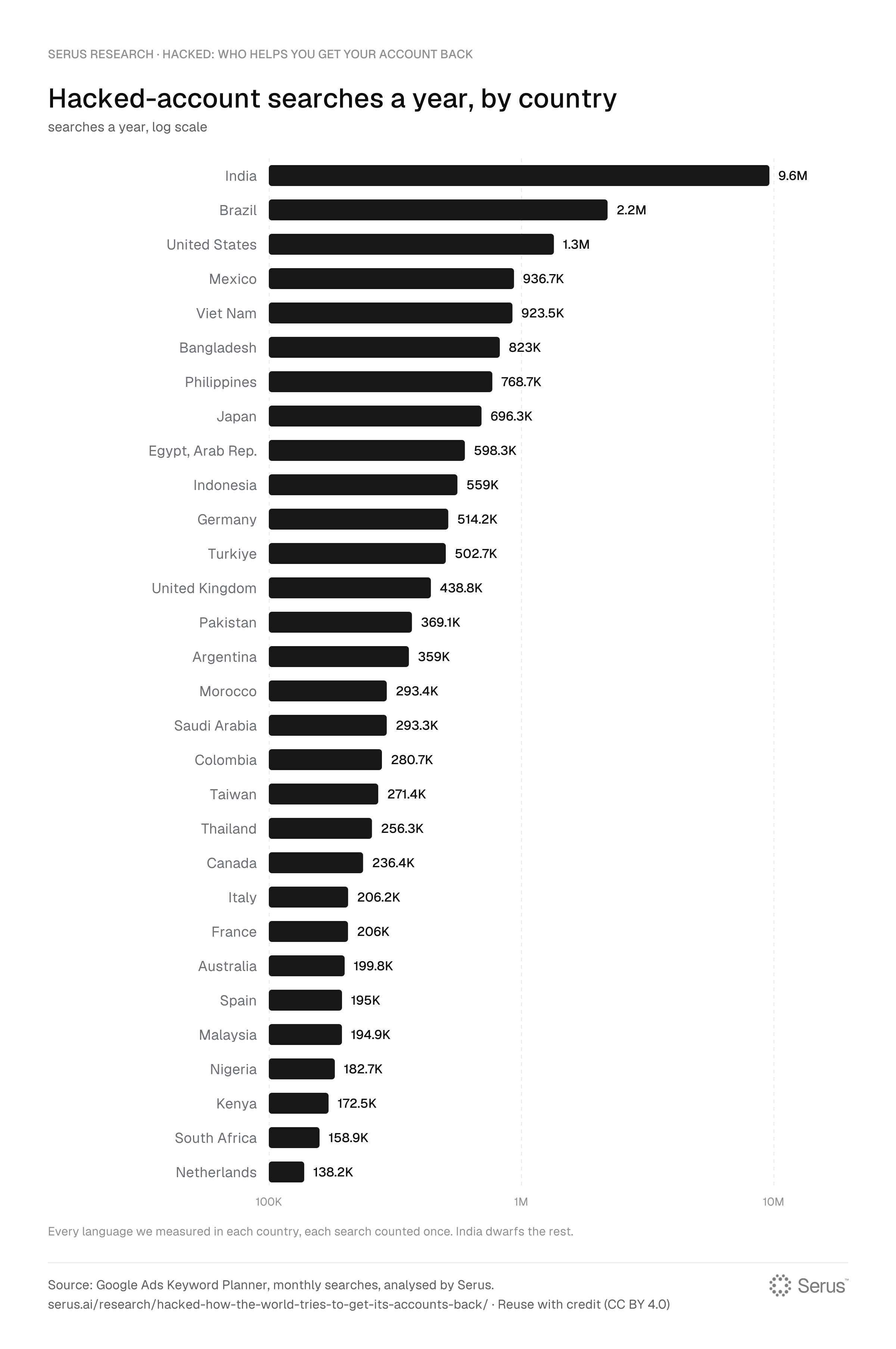
India searches the most by far: about 9.6 million times a year on Google, mostly about Instagram. Brazil follows with about 2.2 million and the United States with about 1.3 million.
The ranking follows population and how much of the country is online, so it's worth reading next to the per-person rates below.
Hacked-account searches a year, by country
searches a year, log scale
| Label | searches a year |
|---|---|
| India | 9,631,110 |
| Brazil | 2,199,930 |
| United States | 1,347,820 |
| Mexico | 936,710 |
| Viet Nam | 923,520 |
| Bangladesh | 822,970 |
| Philippines | 768,690 |
| Japan | 696,320 |
| Egypt, Arab Rep. | 598,310 |
| Indonesia | 558,990 |
| Germany | 514,220 |
| Turkiye | 502,660 |
| United Kingdom | 438,790 |
| Pakistan | 369,120 |
| Argentina | 358,990 |
| Morocco | 293,390 |
| Saudi Arabia | 293,290 |
| Colombia | 280,700 |
| Taiwan | 271,440 |
| Thailand | 256,300 |
| Canada | 236,400 |
| Italy | 206,170 |
| France | 205,990 |
| Australia | 199,800 |
| Spain | 195,030 |
| Malaysia | 194,900 |
| Nigeria | 182,650 |
| Kenya | 172,530 |
| South Africa | 158,910 |
| Netherlands | 138,160 |
Where people search most per person
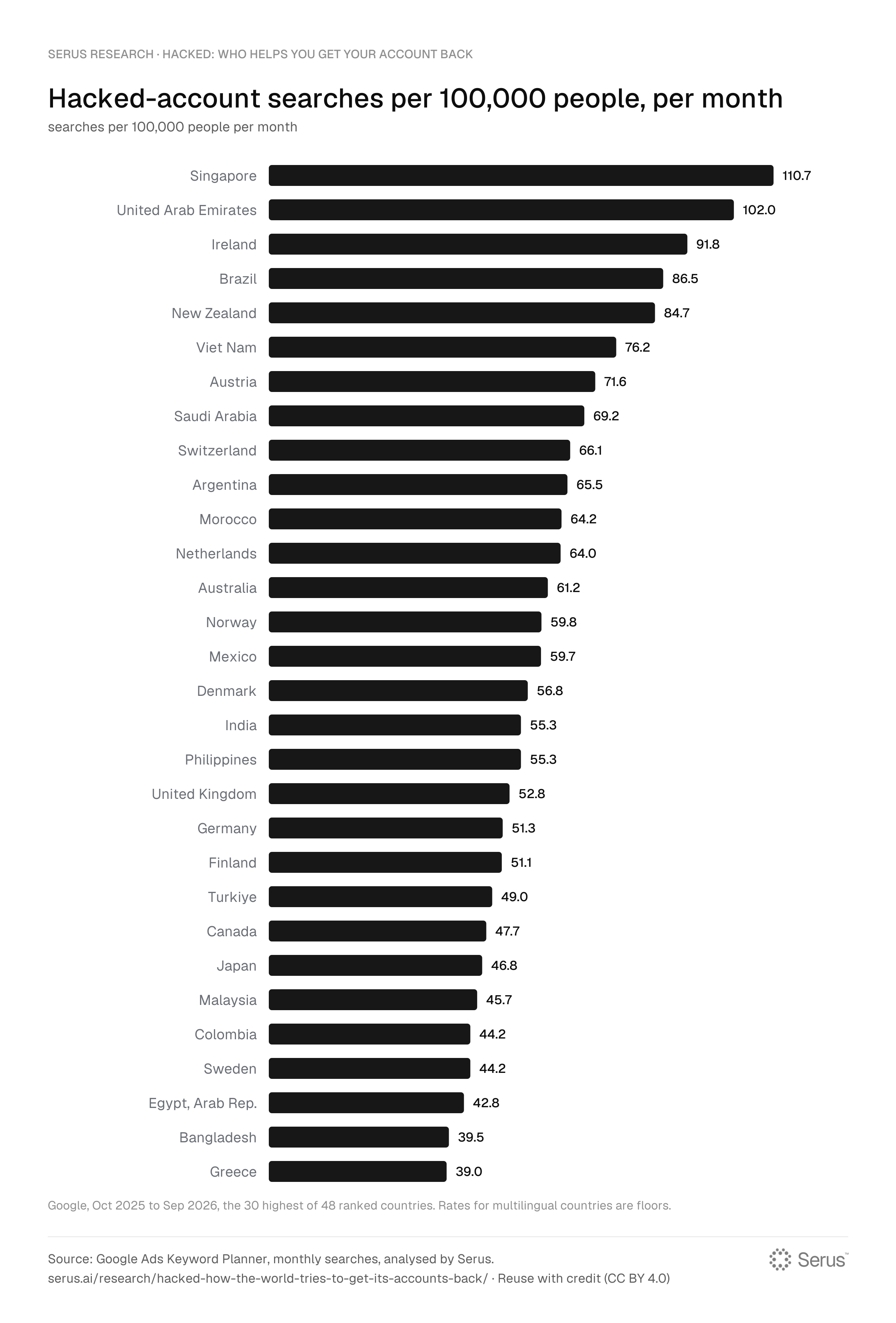
Adjusted for population, Singapore searches the most: 110.7 hacked-account searches per hundred thousand people a month. The United Arab Emirates (102.0) and Ireland (91.8) follow. Brazil (86.5) and Viet Nam (76.2) are the highest outside the rich world; the US rate is 33.0.
Searches fell in 46 of the 49 countries over the last year, the US by 46.9%. Only Viet Nam, South Korea and Saudi Arabia rose, each on one or two terms. Part of the fall may be a change in Keyword Planner's estimates, so we don't read it as fewer hacks.
Hacked-account searches per 100,000 people, per month
searches per 100,000 people per month
| Label | searches per 100,000 people per month |
|---|---|
| Singapore | 110.7 |
| United Arab Emirates | 102.0 |
| Ireland | 91.8 |
| Brazil | 86.5 |
| New Zealand | 84.7 |
| Viet Nam | 76.2 |
| Austria | 71.6 |
| Saudi Arabia | 69.2 |
| Switzerland | 66.1 |
| Argentina | 65.5 |
| Morocco | 64.2 |
| Netherlands | 64.0 |
| Australia | 61.2 |
| Norway | 59.8 |
| Mexico | 59.7 |
| Denmark | 56.8 |
| India | 55.3 |
| Philippines | 55.3 |
| United Kingdom | 52.8 |
| Germany | 51.3 |
| Finland | 51.1 |
| Turkiye | 49.0 |
| Canada | 47.7 |
| Japan | 46.8 |
| Malaysia | 45.7 |
| Colombia | 44.2 |
| Sweden | 44.2 |
| Egypt, Arab Rep. | 42.8 |
| Bangladesh | 39.5 |
| Greece | 39.0 |
Where people ask for help
83.4% of hacked-account searches go to Google, 13.8% to other search engines and 2.9% to AI assistants.
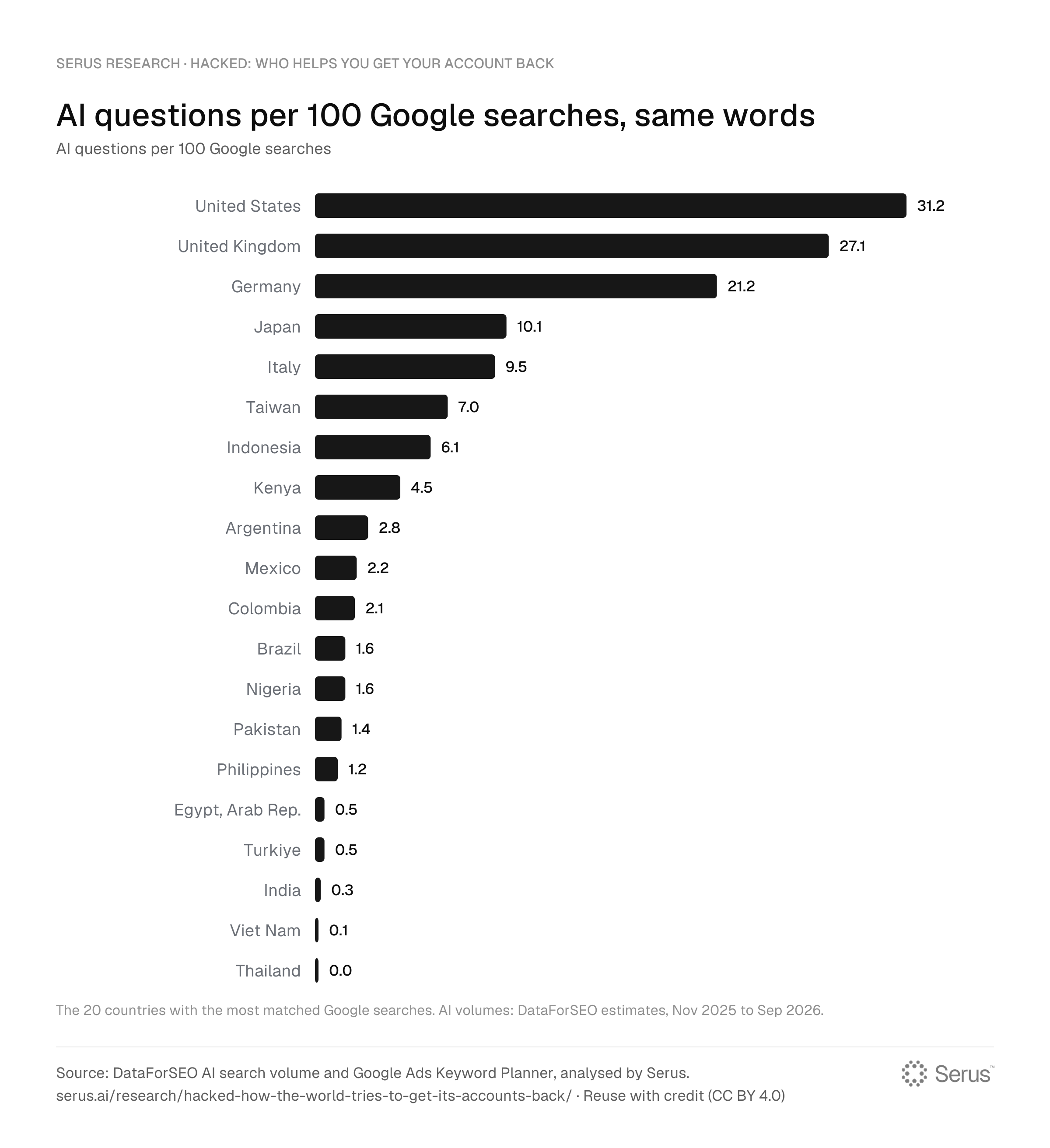
The AI share depends on where you live. In high-income countries, people ask an assistant about 9.4 times for every 100 Google searches on the same words (31.2 in the US). In lower-middle-income countries it's 1.4. So the assistants that pointed to the fix almost every time in our test still get a small part of the questions.
AI questions per 100 Google searches, same words
AI questions per 100 Google searches
| Label | AI questions per 100 Google searches |
|---|---|
| United States | 31.2 |
| United Kingdom | 27.1 |
| Germany | 21.2 |
| Japan | 10.1 |
| Italy | 9.5 |
| Taiwan | 7.0 |
| Indonesia | 6.1 |
| Kenya | 4.5 |
| Argentina | 2.8 |
| Mexico | 2.2 |
| Colombia | 2.1 |
| Brazil | 1.6 |
| Nigeria | 1.6 |
| Pakistan | 1.4 |
| Philippines | 1.2 |
| Egypt, Arab Rep. | 0.5 |
| Turkiye | 0.5 |
| India | 0.3 |
| Viet Nam | 0.1 |
| Thailand | 0.0 |
Each country has its platform
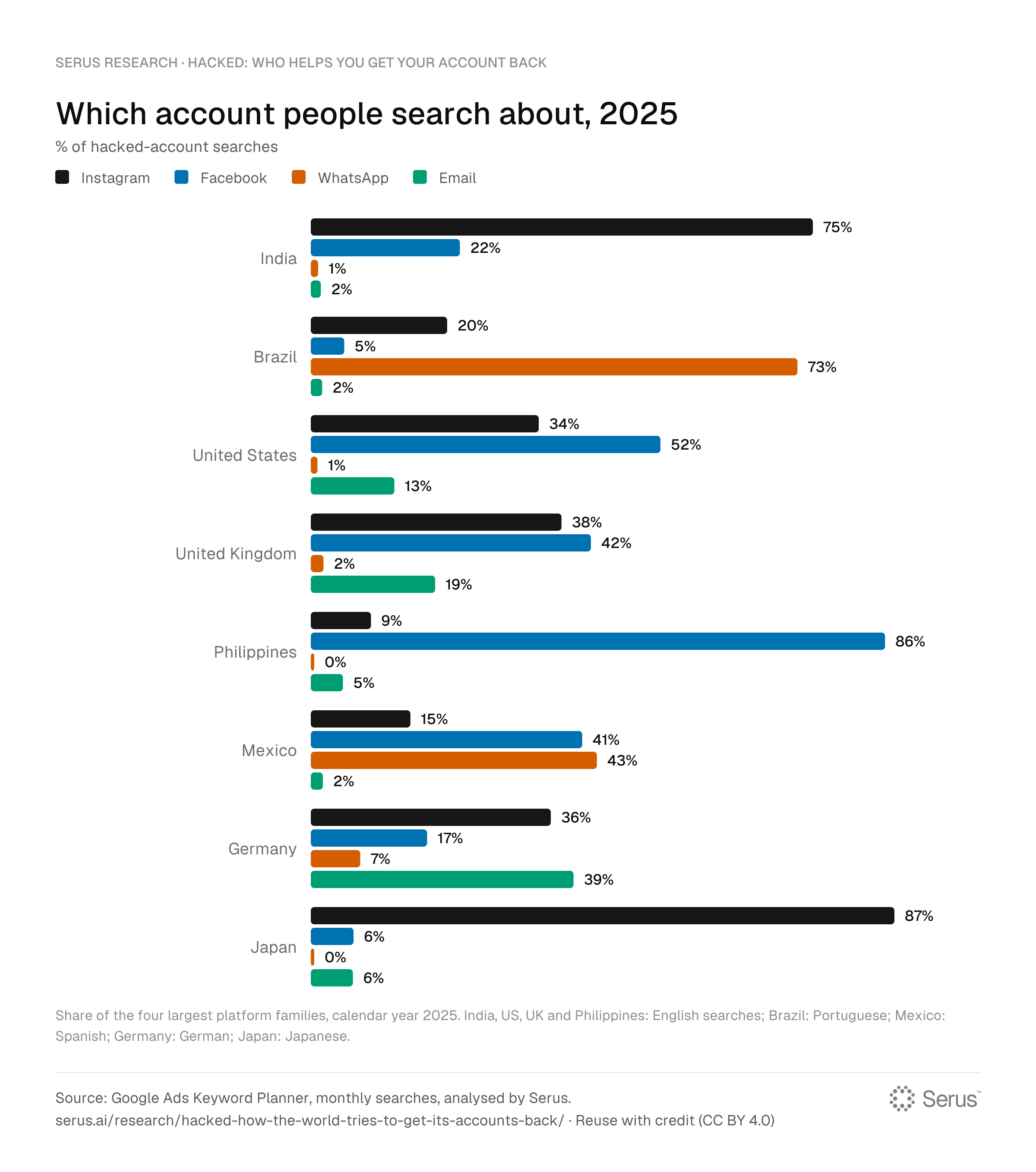
Which account people lose depends on where they live. In 2025, Instagram made up 75.1% of India's English hacked-account searches and 87.3% of Japan's. Facebook led in the Philippines (85.9%). In Brazil, WhatsApp made up 72.8%.
So the weakest spot in the test, Instagram, is also the account the biggest market searches about.
Which account people search about, 2025
% of hacked-account searches
| Label | ||||
|---|---|---|---|---|
| India | 75% | 22% | 1% | 2% |
| Brazil | 20% | 5% | 73% | 2% |
| United States | 34% | 52% | 1% | 13% |
| United Kingdom | 38% | 42% | 2% | 19% |
| Philippines | 9% | 86% | 0% | 5% |
| Mexico | 15% | 41% | 43% | 2% |
| Germany | 36% | 17% | 7% | 39% |
| Japan | 87% | 6% | 0% | 6% |
Hacks reported to police
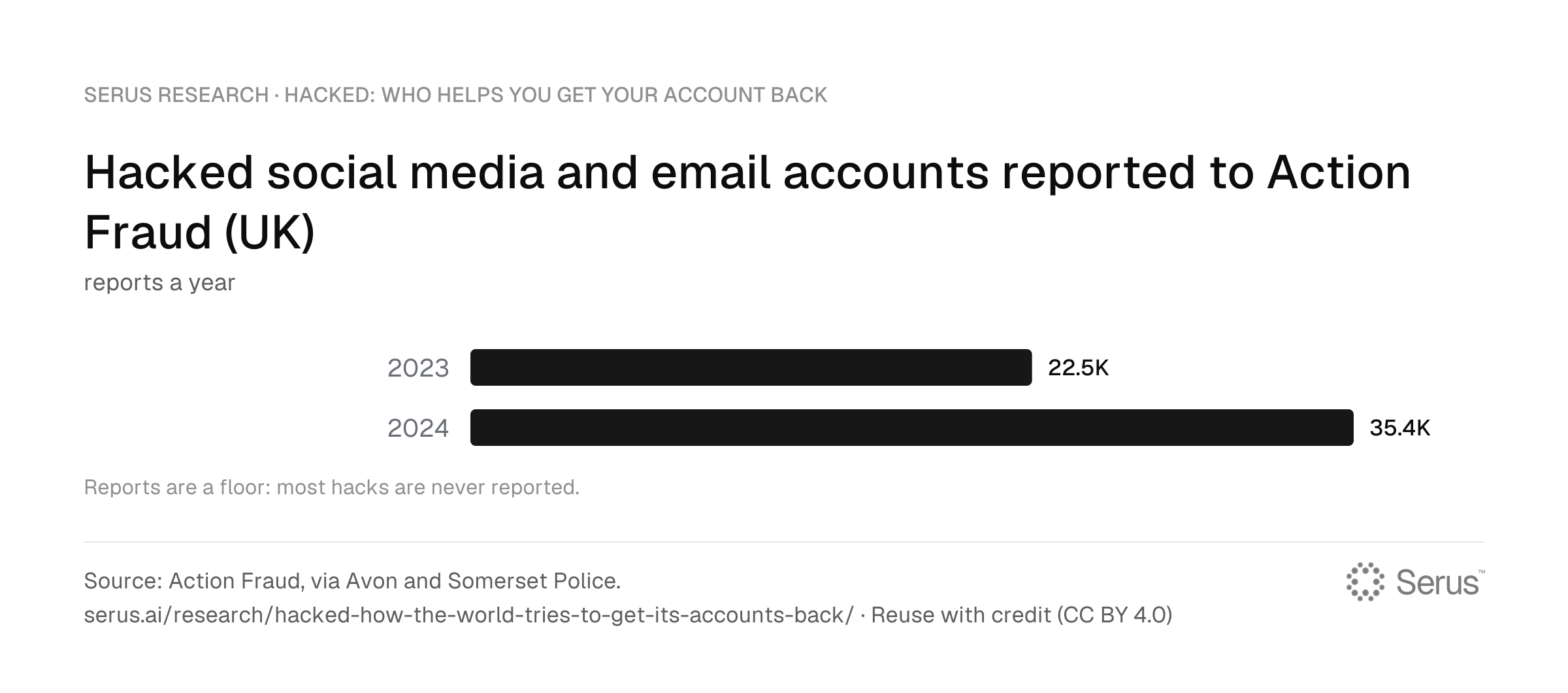
Few hacks reach the police. In the UK, Action Fraud received 35,434 reports of hacked social media and email accounts in 2024, up from 22,530 in 2023, with reported losses of about £961.5k. On Google, the UK searched about 438,790 times for help with a hacked account over the year to September 2026.
In the US, people reported losing about $2.1 billion in 2025 to scams that started on social media, $794 million of it on Facebook (FTC).
Hacked social media and email accounts reported to Action Fraud (UK)
reports a year
| Label | reports a year |
|---|---|
| 2023 | 22,530 |
| 2024 | 35,434 |
What you can do
- Start at the platform's own recovery page: instagram.com/hacked, facebook.com/hacked, g.co/recover for Google, and WhatsApp's re-registration with the SMS code. It's free.
- Ignore anyone in comments or DMs who offers to get your account back. Thank-you comments naming an "expert" under recovery videos are part of the pitch.
- Don't pay to recover an account. The platforms' own recovery flows are free.
- Once you're back in, turn on two-step verification and check which devices are logged in.
- Report the hack: Action Fraud in the UK, reportfraud.ftc.gov in the US.
How the worldwide figure was made
Google, counted. Keyword Planner's worldwide volumes in 34 languages, October 2025 to September 2026, each search series counted once across all languages: 25.8 million a year. Keyword Planner sometimes gives a victim phrase and an attacker spelling one shared series ("instagram hacked" and "instagramhacker"); we drop those series whole, so real victim searches are left out and the count is a floor.
Google, estimated. The 49 measured countries use their own counts. For every other country we took the searches per hundred thousand internet users a month in measured countries of the same World Bank income group (medians: 54.5 high-income, 55.9 upper-middle, 70.4 lower-middle) and applied them to its internet users (World Bank). Low-income countries, none of them measured, get the lower-middle 25th percentile. Low, central and high use the 25th, 50th and 75th percentile rates: 29.3, 31.9 and 33.1 million.
Other search engines. Each country's Google searches divided by Google's share of search there (Statcounter, 12-month average; the continent's share where we had no country file). China is left out: Google has 1.9% of search there and Baidu has no public volumes. Where we could measure Bing directly, it was lower than Statcounter's shares imply (US 7.1 against 11.0 per 100 Google searches, Germany 5.2 against 9.6), so this part may be on the high side.
AI assistants. DataForSEO's AI search volumes for the same terms in 45 countries, as a ratio to Google, applied by income group.
Not counted: YouTube search, help pages inside apps, and China.
Methodology and limits
The test. 40 questions a day on two days, one answer per tool per question. Answers change with time, place and account, so this is a snapshot, not a ranking of the tools. The labelling rules were fixed before each run; after day two we corrected two rules (WhatsApp's SMS re-registration in Spanish, French and Portuguese, and warnings against recovery scammers read as recommendations) and relabelled both days with the same rules. After the independent check we also counted Relyshield, which sells account recovery, as a paid service on both days.
YouTube. YouTube's own search, not Google's, for the same 40 questions on 18 Nov 2026: one search per question, top 25 results, view counts and the top 100 comments per video (by relevance, no replies) from the YouTube Data API. Comment authors weren't stored. Pitches were flagged by fixed rules; after independent checks found missed pitches, we added rules for names placed "on Instagram", for praised names with hack, crack or tech in them, for Portuguese ads naming a recoverer, and for names already praised in another pitch, and ran everything again. Every flag was read and the hand check only removed flags. The language in the table is the question's, not the comment's. A video's view count is not a count of people who read its comments. YouTube searches aren't in the worldwide estimate.
The Google and assistant test. Questions were in English, Spanish, Portuguese, French and German. Google returned 6 to 9 organic results per question (640 in all), and shares are of those; its official share was 14.0% on day one and 19.2% on day two. Fixed rules labelled each result and answer: official route (the platform's own help or recovery page or flow), paid service, general advice, or other (forums, videos, posts). Microsoft Copilot was planned as the fourth assistant but wasn't available through the same service, so Claude took its place.
Reading the pages. Each non-official day-one result was opened and read with its visible comments; YouTube descriptions and top comments came through DataForSEO. Fixed rules flagged recovery-hacker pitches, fake support contacts, pay-or-install pushes and wrong steps; a manual check of every flag only removed false positives, and noted further pitches the rules missed, which we didn't count. Pages with none of these were sorted into official route, general steps only, no steps, or (for videos) not watched; an independent check led us to split that last group out. 153 pages could not be read (blocked or script-only), so the shares are of the 124 we read.
Search data. Monthly Google search volumes from Google Ads Keyword Planner, 49 countries and worldwide in 34 languages, October 2022 to September 2026; the headline window is October 2025 to September 2026. Volumes are rounded estimates. Keyword Planner gives whole clusters one series, also across languages, so each identical series is counted once, and clusters shared with how-to-hack or breach-check terms are dropped. An independent check labelled 100 sampled terms per group and recomputed the headline figures from the raw data.
Platforms. Each country's platform shares come from its main language pull (English for India, Portuguese for Brazil), not from every language spoken there.
Limits. The worldwide figure is modelled, not counted; the Google count of 25.8 million is the measured part. Search also misses people who ask friends or give up, so the estimate is conservative. Most countries are measured in one or two languages, so multilingual countries are undercounted. Russia can't be measured as a country in Keyword Planner; Russian-language searches are in the worldwide count. AI search volumes are DataForSEO's estimates, not counts.
Sources
- Google Ads Keyword Planner: monthly search volumes, 49 countries and worldwide, 34 languages.
- DataForSEO: Bing search volumes (6 countries) and AI assistant search volumes (45 countries).
- Statcounter Global Stats: search engine market share by country, Oct 2025 to Sep 2026, CC BY-SA 3.0.
- DataForSEO: the Google and AI assistant test, and YouTube video comments.
- Action Fraud reports via Avon and Somerset Police: hacked social media and email accounts reported in the UK, 2023 and 2024.
- FTC: US losses to scams that started on social media, 2025.
- YouTube Data API: YouTube search results, view counts and top comments for 40 recovery questions, 18 Nov 2026.
- FTC Consumer Sentinel Network Data Book 2024: identity theft reports by type, US, 2023 and 2024.
- FBI IC3 2025 Internet Crime Report: recovery-scam complaints and losses, US, 2025.
- World Bank Open Data: internet users (% of population), population and country income groups, CC BY 4.0.
How to cite
Serus, "Hacked: who helps you get your account back", serus.ai/research, November 2026. Data and charts are CC BY 4.0.
Changelog
- November 2026: first published, with a YouTube test of the same 40 questions, FBI recovery-scam figures and FTC account-takeover reports.
Download the data
- Countries CSV · 2 KB · CC BY 4.0
- Recovery test CSV · 204 KB · CC BY 4.0
- Serp content CSV · 40 KB · CC BY 4.0
- Youtube test CSV · 178 KB · CC BY 4.0
Questions
What should I do first if my account is hacked?
Go to the platform's own recovery page, such as instagram.com/hacked or facebook.com/hacked. Recovery through the platform is free.
Should I pay someone to recover my account?
No. The platforms' own recovery flows are free. In our test none of the AI assistants recommended a paid recovery service, and the 'recovery experts' praised in YouTube comments follow a copied script.
Are AI assistants better than Google for this?
In our two-day test of 40 questions, the four assistants pointed to the official route in 97.5-100% of answers. 16.6% of Google's top results were the platform's own page. Treat it as a snapshot.
How many people search for help with a hacked account?
We estimate about 38.3 million searches a year worldwide (34.0 to 41.3 million), on search engines and AI assistants. On Google we counted 25.8 million directly in 34 languages.

Author
Anthon WanslandHead of Product & Co-Founder
Shapes the Serus product — from the first address-removal service to the platform it is today.

Reviewed by
Filip Landgren, PhDAbout the data
Free to reuse with credit and a link to this page (CC BY 4.0). Methodology version 1.0.